

If you’re an outdoorsman, you know that a good camping knife is one of the most essential tools you need for an adventure in the wilderness. But what’s equally important is understanding how to use a camping knife.
Given the wide range of activities you might need a knife for — from preparing your food and cutting rope to building a shelter and defending yourself — it’s important to have the skills to use your blade safely and effectively. Here are the eight essential camping knife skills every outdoor enthusiast should know.
Proper Grip Technique
Hold your camping knife with a firm grip, keeping your thumb on the spine of the blade. This will give you the best control and help you avoid accidents while using the knife.
Whittling
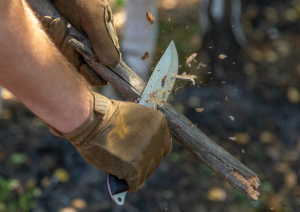
Whittling is a fundamental knife skill you might lean on for everything from carving tent stakes to shaping spoons. For proper whittling technique, use long drawing strokes instead of applying pressure. Start at the base of the wood and work your way toward the end. This will help you avoid accidents like slipping or cutting yourself.
Slicing and Chopping
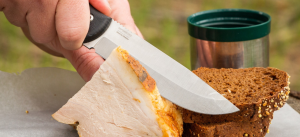
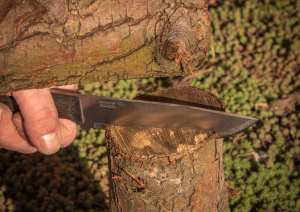
If you’re planning to process wood, chop vegetables or meat, or anything in between, perfecting slicing and chopping is essential. When using a knife for chopping wood, the angle of the blade is crucial. The ideal angle for chopping wood with a knife is around 20-30 degrees, which is slightly steeper than the angle used for general-purpose cutting.
To chop wood with a knife, follow these steps:
- Choose a suitable knife: A heavy-duty knife with a strong, thick blade is ideal for chopping wood.
- Prepare the wood: Choose a piece of dry, seasoned wood and remove any branches or knots.
- Place the knife on the wood: Hold the knife with both hands and position the blade at a 20-30 degree angle.
- Strike the knife: Use a chopping motion to strike the knife into the wood. Be sure to strike the blade at a consistent angle to ensure a clean cut.
Continue to chop the wood, working your way through the log or branch. Be careful not to let the knife slip or become stuck in the wood.
Sharpening
To use a knife effectively, you must keep it sharp. Dull knives are dangerous because they can slip and slide, causing injuries. Here’s a technique you can use to sharpen your knife:
- Choose a sharpening stone: There are many different types of sharpening stones available, but a whetstone is ideal for sharpening knives.
- Prepare the stone: The sharpening stone should be wet. You can either soak the stone in water or simply pour water on top of it before using it.
- Hold the knife firmly in one hand, with the blade facing away from you. Position the blade at the desired angle to the stone (depending on the knife’s sharpening angle).
- Place the blade on the stone and move it back and forth along the length of the stone, using light pressure. After a few strokes, turn the blade over and repeat on the other side.
- Repeat with finer grit: Once you’ve sharpened the blade with the coarse side of the stone, use the stone with fine grit.
To test the sharpness of the blade, carefully run it across a piece of paper. A sharp knife will slice through the paper with ease. Remember to sharpen your knife regularly to keep it in top condition.
Batoning
One of the most important outdoor knife skills is batoning. It’s a technique used for splitting wood for a fire. To baton wood, find a suitable dead branch about one-fourth of your blade’s length. Holding the top of the wood, position the blade of your knife vertically, and strike it from above on the spine several times with a heavy object. Typically, a sturdy branch or log is used to strike the spine.
Firemaking
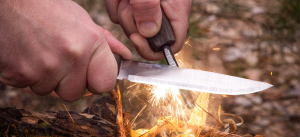
A good camping knife can help you start a fire that keeps you warm and cooks your favorite meals. You’ll need dry wood, kindling, and a fire starter like a Ferro Rod to start a fire. Cut the wood and kindling into small pieces and use your camping knife to create a spark on the fire starter and get the fire going.
Cleaning Your Knife
After using a knife, always clean it properly. Dirt, moisture, and food leftovers can cause your blade to rust or become less efficient. Wipe your blade with a clean rag or towel and use a specialized knife cleaner to ensure it remains rust-free.
Safe Techniques
Finally, you need to know that the most important knife skill is safe handling. Always be aware of the blade’s position and motion. Do not move it erratically.
How do you choose the right camping knife that can be used without any problems for all these skills?
A good camping knife is one of the most crucial tools for any camper. Not only can it be used for preparing food and cutting rope, but it can also be a critical piece of survival gear if you get lost or injured. With so many different sizes, shapes, and materials available, it can be difficult to know which knife to choose. That’s why we’ve compiled this comprehensive list of steps to help you select the right camping knife that can be used without any problems for 8 essential skills.
Consider the Blade Material
When selecting a camping knife, you want to make sure that it is made from materials that can withstand the rigors of outdoor use. Each material has its pros and cons, so consider factors such as durability, corrosion resistance, and ease of sharpening before making your choice.
Decide on the Blade Shape
Camping knives come in a variety of blade shapes, including drop point, clip point and tanto. Each shape has its own unique benefits, so think about how you’ll be using the knife. If you are doing a lot of skinning or carving, a drop point or clip point may be the best option. A serrated blade is more effective for cutting through tough materials like thick rope or wire.
Choose the Right Blade Length
The length of the blade is another key consideration when choosing a camping knife. Generally, shorter blades are more versatile and easier to control, while longer blades are better suited for heavy-duty tasks. Consider how much cutting power you’ll need and what types of materials you’ll be working with to select the right blade length.
Look for a Sturdy Handle
The handle of your camping knife is just as important as the blade itself. Ideally, you want to choose a knife with a handle that provides a comfortable grip and won’t slip out of your hand easily.
Handles can be made from a wide range of materials, including wood, plastic, rubber, and metal. Consider factors such as weight, durability, and ergonomics when selecting the right handle for your needs.
Check the Overall Quality
Finally, when selecting a camping knife, you want to make sure that it is well-made and of high quality. Look for a knife with strong, durable construction and check to see if it comes with any additional features, such as a sheath.
Choosing the right camping knife can make all the difference when it comes to enjoying a safe and successful outdoor adventure. By considering blade material, blade shape, blade length, handle material, and overall quality, you can select a knife that is perfect for your needs.
Remember to prioritize durability, comfort, and effectiveness when making your choice, and invest in a high-quality camping knife that you can rely on for years to come.