
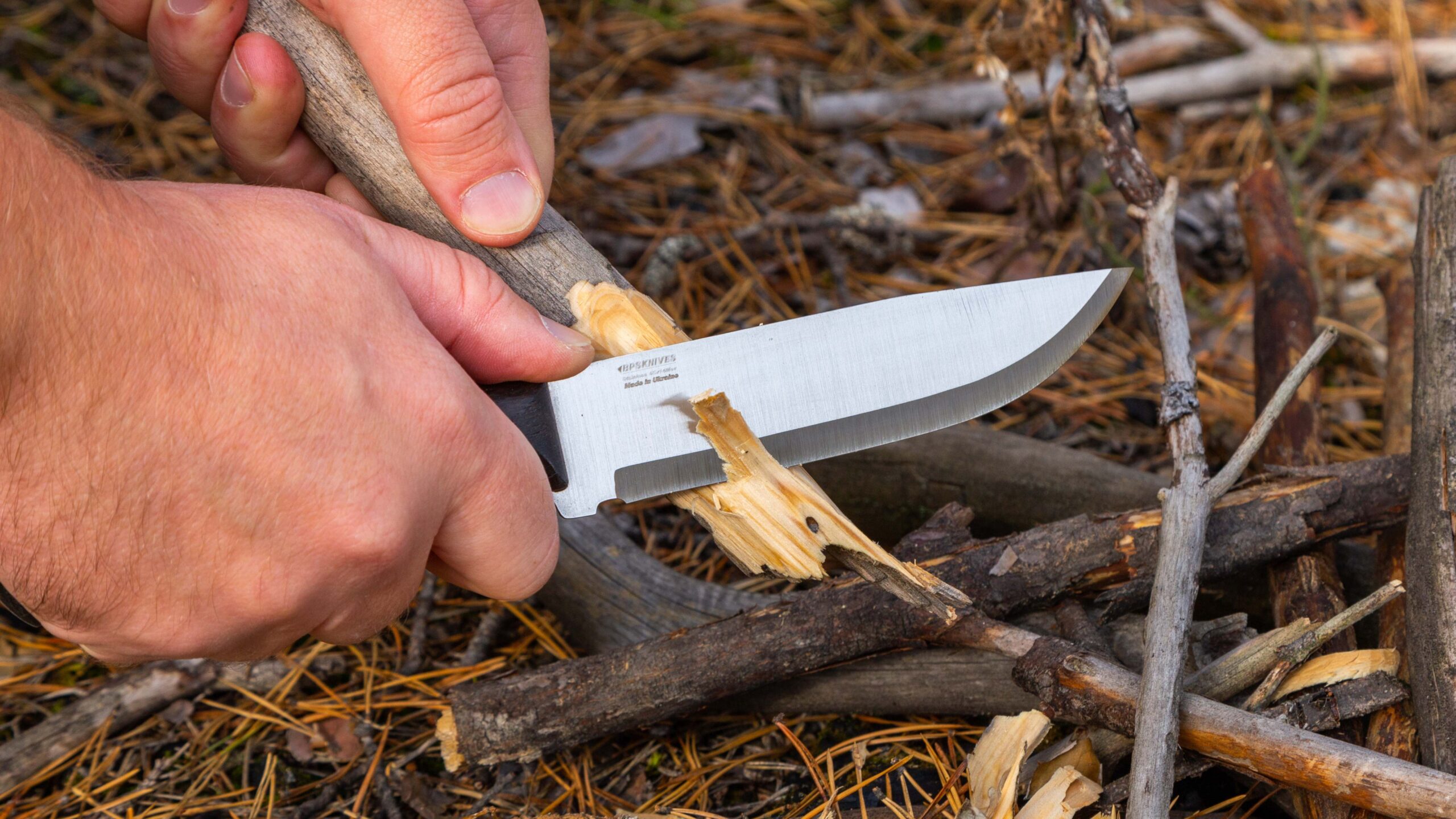
Here’s some tips that might help you save your fingers from being cut. Of course, we all remember these rules, derived from common sense, but for the sake of safety we would outline some guidelines.
Top 5 tricks and tips that would save your fingers while using a fixed blade knife
#1: Keep your blade sharp at all times and ensure regular maintenance. This would accommodate for dulling after the extended use, which makes knives much more dangerous and harder to use. Regular maintenance would help to keep the rust and dirt away from high-carbon blades, which require oiling each 1 to 2 months along with dedicated honing.
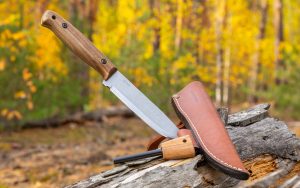
#2: Using a sheath helps to reduce risks plus a knife is available “on-demand”. Proper holding sheath assures you won’t cut yourself, protecting the blade from elements. Sheathed knife is 100% safer to carry while moving, thus making you much more mobile while ensuring you can cut things when you want to. At BPS Knives we sell knives along with leather, stitched by high-quality threads of specialized nylon. Since we aim to provide a traveler with reliable tools, we also add Ferro Rods to some models of our bushcraft and survival products. Great knife with leather sheath and Ferro Rod – Adventurer CSHF by BPS Knives.
#3: Point the knife away from yourself always, at all times. Since the blade points outwards, there’s less chances of stabbing yourself during movement through tight spaces. This also helps to protect yourself during woodworking, survival and wilderness tasks. Holding a knife this way would help to avoid finger cuts too.
#4: Be calm at all times while holding a knife. Knives are sharp, always, and thus are easy to be cut yourself with. Holding a steady and calm stance would help you to avoid unnecessary problems with a blade. Plus, calm behavior makes you appear less dangerous to other people, which translates in less unnecessary alarms for others.
#5: Hold the knife firmly at all times. Ensure rigid grasp over the handle at all times during your work. This would help to avoid most of the problems
Safe and Effective Chest Lever Grip:
- Hold the knife like a reversed hammer with the pommel against your chest and the edge pointed at your elbow.
- Hold the piece of wood in your other hand.
- Keep your arms close to your body and place the knife on top of the wood in front of your chest.
- Pull your shoulders and elbows back to make a controlled cutting motion into the wood.
- This engages your back and chest muscles, allowing you to apply force safely. The knife won’t move, so it’s a secure technique.
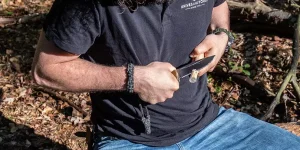
Photo from knivesandtools.com
Efficient Knee Lever Grip — Position the knife’s spine against the front of your knee. Apply pressure by pulling the wooden object forcefully. The worst that can happen is the wood shifting, much safer than a flying knife.

Photo from knivesandtools.com
Creating Notches. When crafting tent pegs or finding a point to secure your tarp with rope or paracord, mastering the skill of notching is highly practical. Here’s how to do it:
- Position yourself closely above your workpiece.
- Hold the knife in one hand and support the branch’s base with the other hand.
- Keep your hands in close coordination to protect your fingers.
- Place the knife precisely where you want the notch.
- Use your thumbs to press the knife’s spine, ensuring a controlled cut into the wood.
- If possible, angle the knife diagonally to achieve a more extensive cut than a simple push.
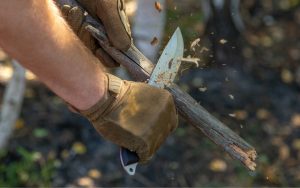
You can always equip a pair of gloves while using a knife in the wild. These can help your hands remain warm during colder seasons, protect skin from elements and damage, such as cutting your fingers. This can come in handy at all times, which is just nice. What type of gloves to pick is up to you, but leather gloves are much more resistant and durable for the survival scenario.
Don’t use knives to attack animals or people. This is a modest reminder to always stay away from trouble and danger.