
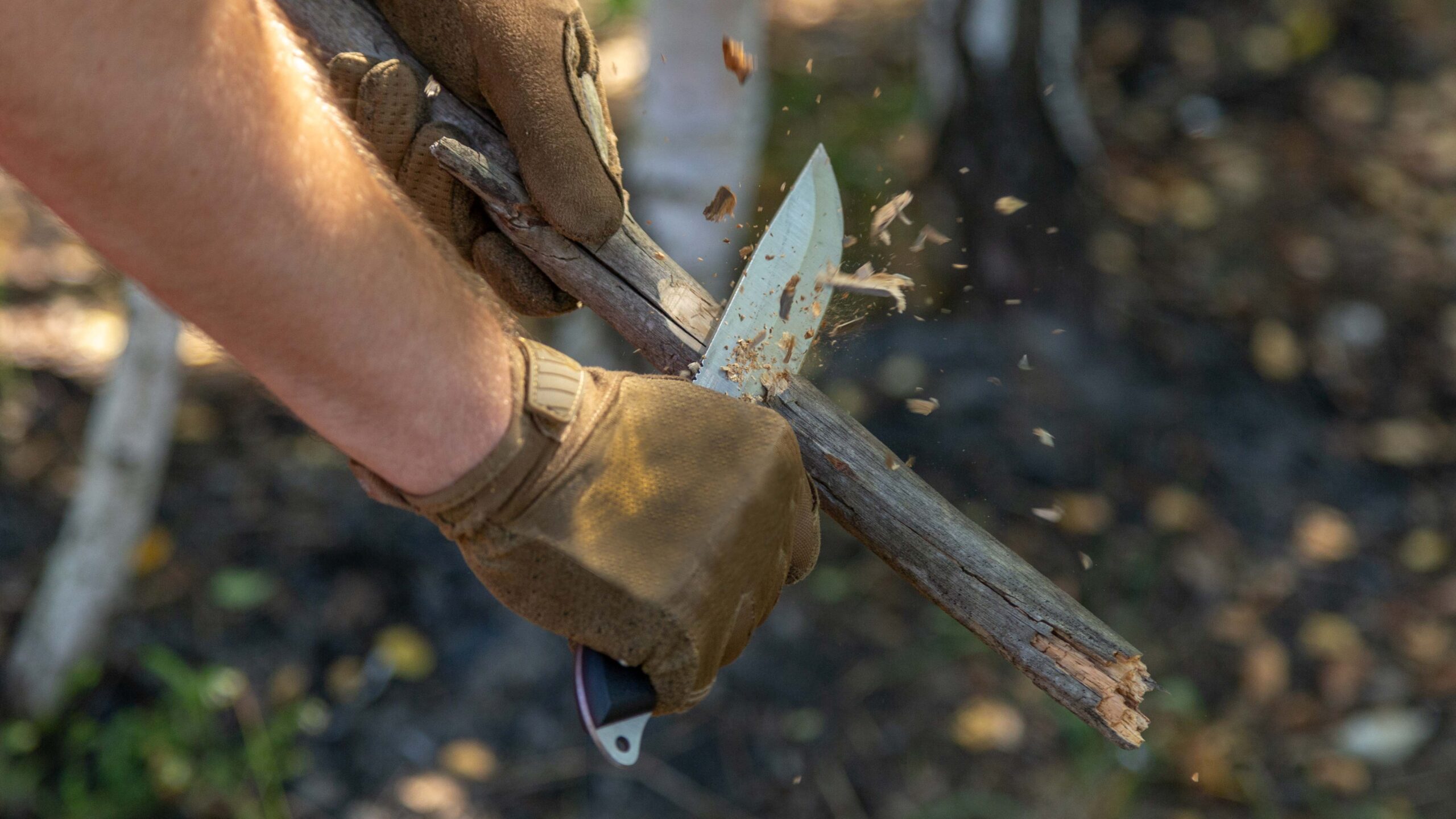
What is HRC, is it different from Rockwell Hardness C? How is Rockwell Hardness calculated and what is Rockwell Hardness C? Which hardness type influences the blade qualities most? This article has every blade hardness topic covered.
What is Hardness of the blade and how is it measured?
Hardness is not the most crucial factor when picking a blade. Indeed, blade hardness is a sole factor responsible for the longevity of the knife, and the self-evidential truth is that softer blades break faster than harder ones. However, other factors play a role too, such as weight, way of hardening, chemical properties of the steel and its content.
Hardness of the blade is expressed by 4 types of tests. There are testing methods such as Rockwell Hardness C, or HRC, Brinell, Vockers and Knoop tests. Each with a different purpose:
- Knoop test is geared towards testing softer materials like gold without damaging them.
- Vickers test is used to determine softness of easily shapeable and thin materials, such as different types of films and membranes.
- Brinnel is used to accurately determine average hardness in blocks of material with inconsistent structure, like wood or lumber.
- As per 2023, HRC or Rockwell Hardness C (Conical) is the most widely used metric for the conventional, combat, survival, tactical, sports and cooking knives. When talking about blade hardness of the knife — HRC score is used.
What is HRC and how to understand it? HRC stands for «Rockwell Hardness C». The «C» here means Conical, which is how the test is being done — by using a heavy diamond cone, typically weighing 10 kilograms. Grossly simplifying, to determine hardness this cone is pressured into metal with the 150 kg of force for a short period, and HRC value shows how deep it can go during that time. This test is made specifically in order to test iron, steel and other metallic alloys for hardness.
HRC testing is composed of 3 stages:
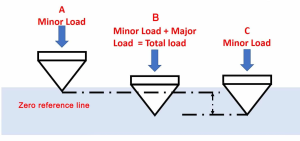
Photo from hardnesstesters.com
What does the HRC test look like?
- Blade is placed on a flat, even and smooth surface. This surface should also be able to withstand 200 kilograms of combined pressure without breaking.
- Blade is slightly pressed with a 10 kg diamond cone. Simply put — only G, or force of Gravity is used to dent a steel at this stage. This is a «preload» stage of testing, which is used to form a reference line for later calculations.
- Cone is pressed into the blade with the added force of 150 kg; This is done by gently pushing the cone into the steel, gradually increasing the load to avoid damaging tools or testing material. After 150 kg/f is reached, the diamond cone is disengaged. This is called the «Major Load» phase.
- Then, the blade is slightly pressed with a 10 kg cone again, while only using gravity as the main source of force.
- Average indentation depth is then calculated. In some cases, digital or even probing microscopes are used to determine the depth of indentations up to 0.0008 mm.
Photo from sheffieldgaugeplate.co.uk
How do you calculate Rockwell Hardness C, or HRC? The formula you’re looking for is HR = N − h*d, where:
- HR — is a hardness number;
- N and h — scale factor;
- d — depth of penetration in mm.
For Rockwell Hardness C you’re going to use h = 500, with N = 100. Therefore, your formula to calculate HRC should look like this: HR = 100 — (500*d); Now, for a HRC 59 blade, diamond cone must penetrate the surface for about 0.082 mm. Let’s try to reverse-calculate the equation: HR = 100 — (500*0.082), which translates into HR = 100 — 41, and then 59 — the final hardness number, referring to the level of resistance to the pressure applied.
Keep in mind that given formula and calculations are correct only for Rockwell Hardness «C» Scale. There’s also A, B, D and around 20 other types of Rockwell tests alone, each using different methodics and designed with certain materials in mind. You can find a full list of data on HRC in ISO 6508, along with specifications and measurement equations.
Is there a hardness standard for each knife type? In fact, yes, you can categorize knives by their hardness score on the Rockwell C scale to a certain degree. Some blades are made softer just because they need it, while others have to be harder and thus — less flexible. Nature of the HRC testing does not account for bending, batoning or hammering of a knife, likewise — dynamic loads.
What can you deduce from the hardness of the blade?
Since we’re on the same page on hardness calculation, we now can discuss how hardness changes the blade behavior.
Does hardness of the blade influence the edge retention? HRC scale represents only a fraction of factors responsible for edge retention properties of the knife. It does, however, tell you how strong the steel used for production is against a diamond cone in controlled conditions. Likewise, chemical composition, hardening process and subsequent tempering define how brittle the knife would be, contributing to overall edge retention.
Does the harder blade mean a better knife? Not necessary, high HRC values are often connected with increase in brittleness of the blade and risk of chipping. Without proper heat treatment, HRC 60 would be as usable as a HRC 40 for its specific applications, such as cutting softer steels, chiseling stone or drilling concrete. At BPS Knives we always properly heat treat the knives to reduce brittleness and improve overall plasticity of the steel, while making it harder to break and lose an edge.
Here’s some references to deduce the blade behavior with HRC scale:
45 to 52 is considered a “medium” hardness; This is the level of copper alloys, but can also be applied to certain tools, such as woodworking chisels. You can find some of the screwdrivers and pliers at this hardness point. This is where material can be dented if an adequate amount of force is applied. At this point, the blade will hold an edge against most of the materials, but not for long — with adequate abuse, resharpening would be required every 3 to 6 weeks. Edge of the blade with a hardness of 47-50 will get burrs often from cutting the harder materials.
53 to 56 is a “medium-hard” level; Most of the knives in this category are specialized for general cutting, which does not imply putting significant force over the blade. At this point the blade holds an edge against most of the hard materials, except for harder steels. Burrs won’t appear as much, and edge retention properties allow knives to remain sharp longer — from 1 to 2 months of active abuse before resharpening.
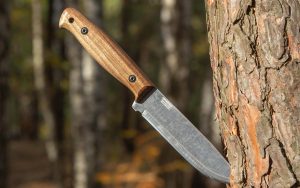
What is the sweet-spot of hardness for a blade? 57 to 59 is “dense” hard; At this point, the knife is going to hold its edge against hardwoods, bones, soft metals like aluminum or copper, and dense meats. The edge won’t require frequent sharpening, as hardened steel can sustain it for 3 to 4 months of adequate abuse. Blade would resist breaking and batoning, but only if proper HT is done beforehand. Most models by BPS Knives have such hardness. Great example of bushcraft knife – Adventurer CSHF.
Does a harder blade make a better knife? Over 60 HRC is the “overkill” zone; This hardness level is required when you want a durable, single-purpose knife such as specialized Santoku-type knives, or single-beveled blades with multiple layers. During most of the survival and bushcraft scenarios, this is unnecessary complication, which makes it harder to re-sharpen knives in the wilderness. However, given the proper HT, you can end up with a durable and long-lasting knife, which would hold its edge for a long period against most of the metals and organic matter.
Can the blade become brittle if it’s hardened too much? Yes, in fact, hardening is followed by tempering in order to reduce stress in the alloy after rapid heating. Such a knife won’t hold an edge well and can be chipped easily if subjected to shock.
What are the drawbacks of blades with high hardness? Some may say that the higher the HRC score of the knife, the harder it is to sharpen the edge. This is true to a point: harder steels are generally more resistant to grinding, and may require specialized tools to do so; on the other hand, higher HRC score tells us that the edge can remain in good condition longer
Does blade grind influence edge retention more than HRC? Thin blades, such as with Hollow or Single-Beveled grinds, have less material supporting the edge. Hardness only influences basic edge resistance of the knife, while Grind Type is something like a multiplication factor for this value. Thus, Grinds suited towards supporting the edge would benefit the most from higher HRC score.
Stay Sharp.