
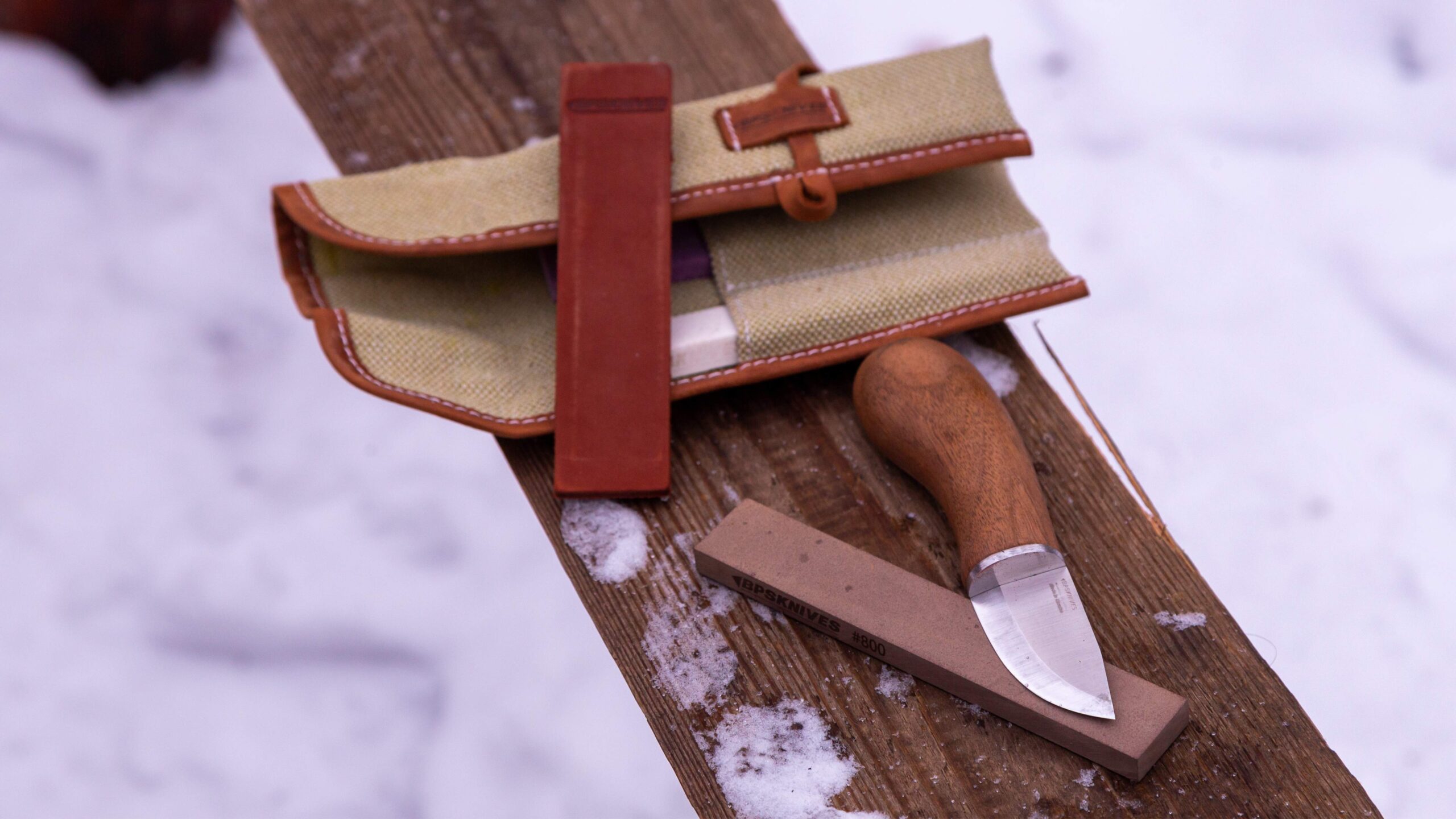
Let’s take a look at how to recover partially dull, chipped or fully dull blades in fields and at home.
How to properly re-sharpen and repair partially dull knife
Dull knives damage material during cuts, leave uneven slices and may pose a danger while doing power cuts. Sharpening a partially dull knife is easier than doing so with a fully dulled blade.
Examine the weak points on the edge beforehand. Take a closer look at your edge, use a macro camera if available, and try to determine the weak spots where the edge is coarser than the rest. Mark it with a sharpie to keep a track of where you’re working with the blade.
Grind bevel before heat treatment, but sharpen afterward. If you are considering subjecting your dull knife to a heat treatment — just to shoot two ducks in one shot — then consider grinding a bevel for the edge before fine sharpening and heat treatment. Your best option for this is an electrical grinder. After you grind the bevel, or secondary bevel if needed, perform Heat Treatment and then sharpen your knife as usual. Be sure to make a Stress Relieving heat treatment for the steel before sharpening it to remove as much internal stress as possible.
Why is keeping an angle important during dull knife recovery? While sharpening a dull knife, you need to keep the same angle of attack as with the rest of the blade in order for the micro bevel on the damaged side to be at the same level as the rest of the edge.
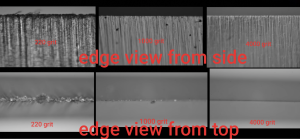
On the screenshot you can note a difference between #220 and #4000 grits. These are all edges suitable for cutting, but the #220 edge is coarse after being roughly grinded. To repair the edge fully, during the resharpening stage you’re going to increase grit level over the course of sharpening — step by step.
What is the best option to recover dull knives: grinder, whetstone, musat or leather?
- Grinder. With coarse grits it can shave off lots of material fast, provide a workplace and grinding wheel with added momentum; Be careful — grinding might overheat the bevel or damage the bevel geometry. Electrical Grinder is best suited to form a bevel for the fully dull blade or to form a new edge after chipping;
- Whetstone. Slow, manual sharpening, gives you more control over the way the edge is formed. Provides less burr while shaving the material and doesn’t overheat the edge, like the grinder does. This is the tool of choice for manual dull blade repairs;
- Musat. It’s usable to a degree, since sharpening steel «massages» the edge, removing burrs or narrowing out gaps. In simple terms, with musat you are bending out the rolled micro bevel, not removing material. However, honing with musat won’t repair a dull blade;
- Leather. Stropping is an after-sharpening procedure, done to make the blade as smooth as possible, removing tiny burrs and put away corners sticking out of the edge. This improves the final sharpness of the knife.
There are two ways to sharpen a dull section:
- Sharp the whole blade at once; This is fine if you can match the blade previous sharpness level. For example, if it was a fine knife — consider starting with a #500 to #600 grits and working your way up to the #1000. Remember to keep an angle while sharpening a fine knife, otherwise you risk ending up with even a duller blade;
- Slowly grind the dull section, and then resharp the surrounding edge; If you know your angle — keep grinding on the whetstone until this section is done for good and move up a grit level to account for the rest of the edge;
Definition of «partially dull». Let’s assume we’re talking about a certain dull spot on the surface of the edge. On the screenshot below you can note indents from the heavy abuse of the knife. This is what is called «partially dull blade» — when it’s only a certain section you’re working with.
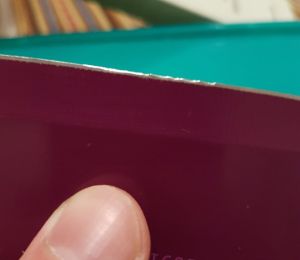
How do you recover that indentation of the knife edge as shown on the screenshot?
- Take the blade and slowly unroll the damaged part of the edge to avoid damaging it further during finer stages; If the edge is rolled too severely, you’ll have to consider a «shave off» of the part.
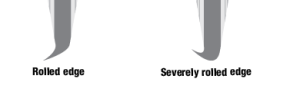
- Pick sharpening angle identical to initial angle of the secondary bevel — the outer line of the edge it is — and slowly start to grind it using medium fine grits;
- If the indents are too severe — you’ll have to shave off the edge enough, to account for dull sections.
Coarse automotive sandpaper is good for thinning and edge restoration simultaneously. But you want to use hard rubber or soft wood as a backing.
What is the proper grid sequence for repairing a partially dull knife?
- Start with #400; Shave off some material for finer stones. Grind until the dull part is being sharpened to the angle of the main edge;
- Move to a #600; At this stage your blade is sharp enough, but can still be coarse. This is fine for most survival knives and hardworking blades; Do 50 times per side, 3 times over.
- Finish with #1200 or #1000; Same — 50 times per side, 3 times over.
- Strop on leather to remove burrs and make a finer edge; Give each side at least 20 strops, and you’re good to go.
Here’s a short reminder on the nature of bevels in a knife:
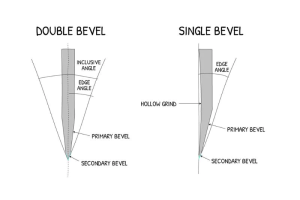
How to sharpen a dull knife from scratch?
Can be sharpened with ease after dulling:
- Full Flat Grind;
- Sabre Grind;
- Convex Grind;
- Scandi Grind;
Avoid if never re-sharpened them before:
- Hollow Grind;
- Chisel Grind;
- Single-Bevel blades;
- Curved Blades.
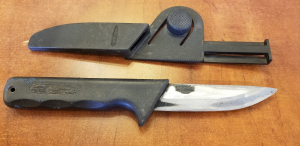
Photo from kitchenknifeforums.com
Even the most dull knives can be recovered. In the picture above you can see what is presumably a «Parker Cutlery» or «Parker & Brothers» non-foldable knife from 1985 with a carbon steel blade made in Japan. This is antiquity by some standards. It sustained heavy use over the time, such as cleaning squirrels, being outdoors during heavy rain for weeks. Owner of the knife estimated that the blade was left in these conditions for over 15 years.
The knife above has a Scandi grind. Not every grind is made equal, Scandi grind is known for easy sharpening — since there’s only 1 bevel and 1 angle to follow.
Corroded an ugly, this blade, however, was restored in a simple fashion:
- #500 Shapton Glass whetstone for shaving off an extremely rounded edge after being used as a gardening tool;
- #1000 Diamond Water Stone, followed with #3000 grit whetstone;
- The stropping stage was done by using Wax on fiber.
How do you repair a chipped blade?
Size matters:
- Generally, to repair chipping over 2.5mm blade edge has to be grinded away to account for damage.
- Tiny chips can be dealt with whetstone;
- Small chips — 2.5 mm — will require some degree of grinding to set a new edge;
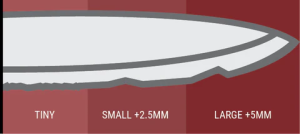
When the cutting edge is chipped your best option is to grind away the old and make a new one.
To do this, you’re going to:
- Draw a line on the knife for a new edge;
- Start with a coarse whetstone to form a new edge;
- After reaching your markings on the knife — sharpen it by gradually increasing grit from coarse to fine.
Some knifemakers do a heat treating of the chipped knife after coarse sharpening. This helps to recover the blade from stress and makes it less prone to chipping afterward. Usually, this is done in a cycle of hardening, followed by tampering. Be sure to follow a simple rule — shave off the bevel for the new edge, then do hardening.
Stay Sharp.