
So, you want to live in the wilderness? Then you’re going to need a good knife for that. Let’s break down the process of picking a bushcraft knife.
Picking your first bushcraft knife — understanding the scenarios
First of all, you should understand the difference between bushcraft, survival, hiking and outdoor recreation.
Outdoor recreation is a simple scenario. You pick a location, take a road trip to the nearest forest or wild park, set up a campfire and make some tasty barbecue, shashlik or kebab from marinated meat. Role of the knife in this scenario boils down to optionally cutting some firewood, plus occasional meat carving. This is a tight timeframe, where you don’t need to account for edge retention, chipping, blade corrosion or handle material.
Every weekend wilderness trip can become a survival scenario. This is where things get hairy: for some reason, be it animals or natural obstacles, you are stuck in the wilderness. The role of a knife becomes much more significant from now on, as you may need to build shelter, gather firewood and set up a temporary camp. The key goal in this scenario is to get out as quickly as possible — under a week. Presumably, you also might encounter aggressive wildlife, and while running is your best option, a good survival knife on the other hand must provide you with decent combat support too.
While hiking, you are supposed to get from point A to point B through the wilderness. In this scenario, the route is planned beforehand, you have some time to prepare and bring in the most weight-efficient tools possible. Therefore, weight requirements restrict your choices, and your knife should be as lightweight as possible to keep space for the additional food and resources. During this scenario, you aren’t supposed to hunt for wildlife, since you expected to bring in some supplies with you.
During bushcraft your goal is to thrive in the wilds. While going for a bushcraft trip you deliberately, for a long period of time, move away from civilization and temporarily change your accommodation. So, you have to bring as many tools to gather, process and acquire food in the wilderness as possible. Requirements for a knife grow — it should be durable, ergonomic, easy to carry, have a certain type of a handle and so on.
What handle type to look for while picking a bushcraft knife?
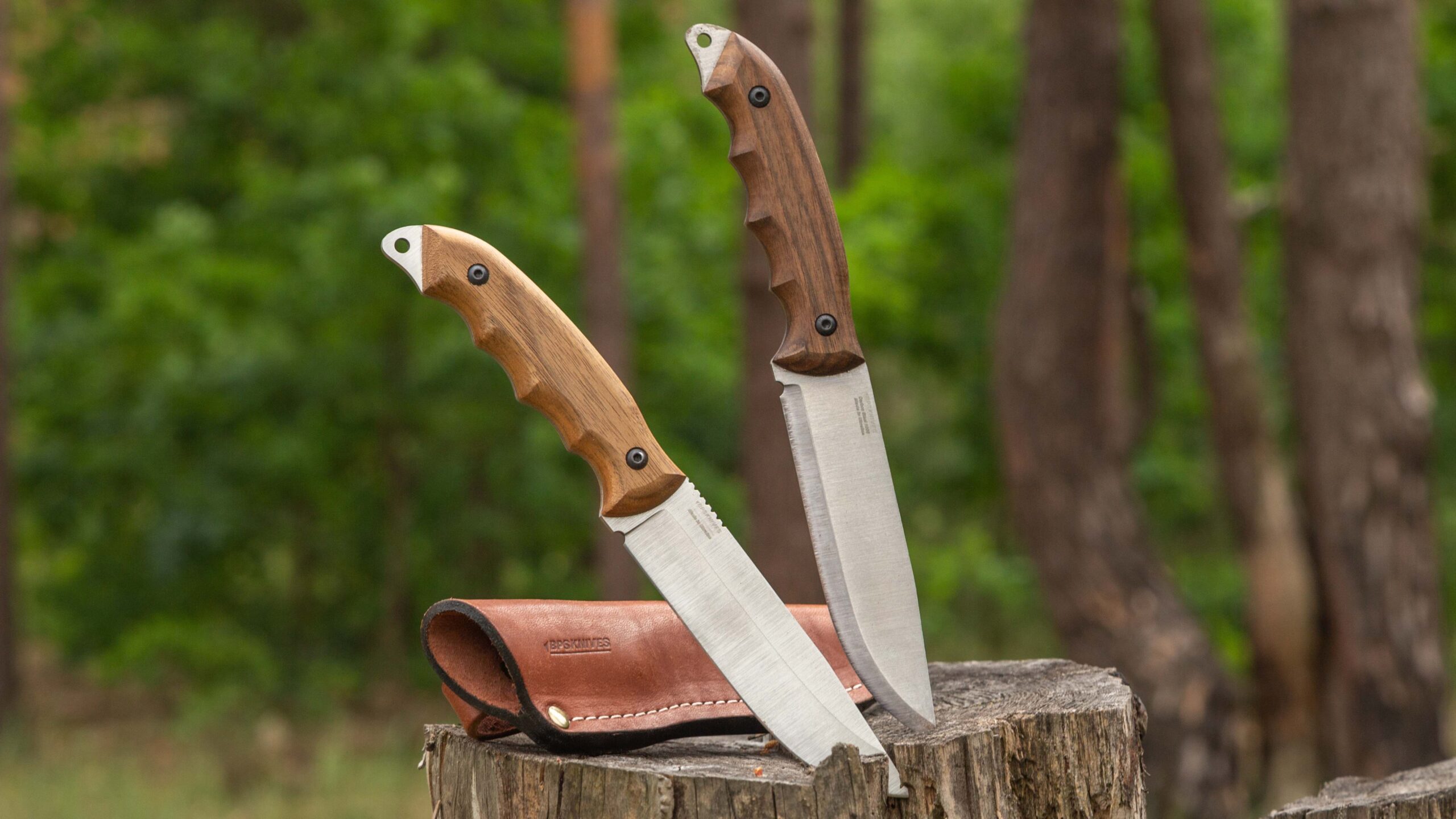
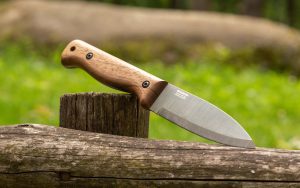
For a wilderness survival scenario, look for a wooden or similarly natural-like textured handle. Due to the natural properties of organic material to store heat better than metal or likewise plastic, you will feel it warmer to the touch while gathering, batoning or butchering activities. Thanks to the Danish Oil coverage of BPS Knives handles, wood would also retain its grip even being covered in fluids. Since the same oil also fills porous parts of the wood, the handle will remain odour-less, making it usable in repurposable trap scenarios.
Micarta handle will be equally beneficial in most weather condition scenarios. Be it winter fishing, crossing a swamp in spring or autumn, Miracta handles are known for their near-bombproof type of durability score. This material retains grip qualities under every wear and tear scenario, while being warm to the touch and resisting break from shock damage. Linen Micarta is known for the least moisture absorption among every type of this material, making it ideal for long-term high-moisture scenarios. If you wish to find such a knife — you could try Citizen SSH by BPS Knives, with spear-point blade and handle made of Micarta.
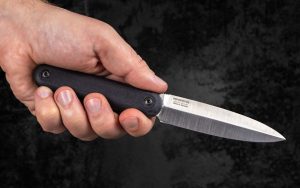
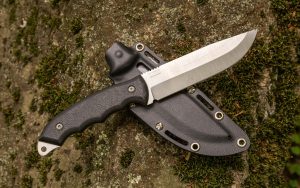
G-10 or plastic-alike handles are generally speaking — fine. There are tradeoffs, however, given the material price-wise low cost of production, such as unnatural feel and better temperature transition among materials. Simply put — it gets colder quicker than wood while being in your hand. Grip qualities are moderate, and it can sustain wear and tear similarly to the wooden or Micarta handles. ABS plastic handles, however, negate most of the downsides and include grip-improvement surfacing, like the Raven SSH by BPS Knives.
What grind type is best suited for the bushcraft knife?
Given the moderate abuse, blade grind type plays a role too. During the bushcraft scenario, you are going to experience a high degree of abuse to the blade. Daily tasks, such as fileting, bone cutting, meat carving, woodworking and machining put a heavy toll on the edge of the blade. To counter this, a symmetrically shaped single-beveled edge is preferred.
Flat Grind is fine if combined with high-carbon steel blades. Since there’s a high level of abuse to the edge, Flat Grind might appear tedious to resharpen with less wear-resistant steels. High-carbon blades are made to counter this problem, but given the time, even this edge can become duller, requiring you to bring some resharpening tools with you.
Scandi Grind is a preferable option to the bushcraft scenario. The Scandi-grind type is suited towards extensive wood-work and carving, with widening material present behind the blade. Most of the BPS Knives, however, use a slightly modified type of the Scandi grind with a thinned bevel behind the edge. This contribution to the blade design allows for ease of resharpening. With additional shock resistance, it also provides a blade with more damage resistance if you wish to use it as a lever. Geometry of the blade makes it especially chipping-resistant in the batoning scenarios, which you may use it for occasionally.
How big should a bushcraft knife be?
Size matters from a usability standpoint. You are going to carry your knife with you alot while bushcrafting, this translates for a lot of daily tasks handled at once. Big blades are generally good to carry around, and with some additions to the handle design they are good for doing a lot of precise and fine cutting.
Medium knives are the “golden middle”. Knives such as Adventurer CSHF by BPS Knives draw the best of two worlds, combining mobility and function during daily usage. Additional size and weight provides more usable force during battoning and slashing or making a good lever for prying something. Provided leather sheath allows for ease of carry during daily routine, making blade always available “on demand” for you.
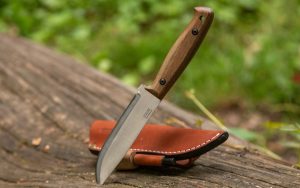
Smaller blades are generally considered the best option. Bushcraft knives are meant to be good utility tools, as meat preparation and vegetable slashing are included into the list of duties of wilderness living. From the ergonomic perspective, it’s better to use smaller knives, as they are easier to carry around you and feel much more manageable while in hand. If you want to handle cooking the most — try B1 by BPS Knives, with stainless steel blade and convenient drop-point blade type.
Stay Sharp.