

Looking for a long-term survival knife? Let’s break down how to find the best survival knife that’s going to serve you a good job even during a 180+ day expedition.
What’s better for survival — Fixed blade Knife or Folding Knife?
Choice of knife type depends on the situation, really. From the redundancy standpoint you should consider both: a straight fixed knife can soak up most of the tasks, while a foldable knife can be reserved for fine cutting.
- Pocket knives bring up the versatility, carrying additional features at the expense of partial tang design, foldable blade and/or multiple moving parts. You can reserve it for fine cutting and precise tasks;
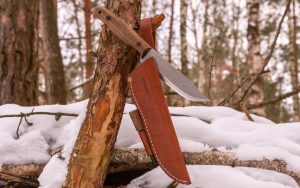
- Sheath Knives are sturdy and can take most of the chopping, slicing and even combat scenarios. Because of their non-foldable design, Sheath Knives are geared towards durability, like the Adventurer CSHF by BPS Knives.
Among Pocket Knives, multitools would be the most usable option, since they provide the most options and add to redundancy. Foldable Pliers, installed into a lot of multitools, allow to unhook fish easily, bend metal parts to do small repairs and hold natural materials for advanced crafting.
What to consider when picking a survival knife?
Let’s assume you’re looking for a reliable, long-term knife, to do some daily survival. This means tear and wear, dirt, moisture and general abuse of the knife. Here’s what you should look for to get a decent and long lasting blade:
- Resistance to the elements. You’re looking for a knife that has a good corrosion, plastic deformation and shock resistances. Stainless steels are good for this, while high-carbon ones may prove more durable, but harder to sharpen and maintain in the long-term wilderness scenario.
- Resilient blade. A good survival knife has to have a good edge retention, which contributes to its overall durability. Proper sharpening might not be an option during a trip, hence the blade itself should be tough.
- Grippy handle. Preferably, you’re looking for a comfortable handle, with resistance to slippage and wetness. Your grip on the handle should be equally good with both dry and wet hands.
Survival knife is 1 ⁄ 3 utility knife. A good survival knife should be a decent kitchen or utility blade too, since you are going to use it much more frequently during the trip. The knife should be convenient to hold while slicing both «on hand» and on something flat.
Avoid oddly shaped blade tips. You only need a sharp and pointy end for this, odd options will make it harder to do precise tasks with a knife. Survival knife is also a self-defense knife, so its piercing qualities should be high too. Here’s a shot lift of tasks where a sharp, pointed spear-like tip stands out over the others:
- Detailed prying and picking;
- Cleaning small game, such as fish or squirrel;
- Making notches or drilling something;
- Clothing and gear repairs;
- Processing pine nuts, acorns, walnuts, and hickory nuts;
- Accessing live bait in hard to get areas.
Consider a solid pommel, or «butt» of the knife. The solid pommel provides an added hammering tool, you can use it to break ice, glass or do general hammering.
Restrain from using ceramic or titanium knives as survival ones. They sound cool in the kitchen and provide specific high-end benefits to their respected users, but are less useful and reliable during survival.
Overall, your blade of choice should also be good to sustain moderate abuse over a prolonged period of time.
What handle should a survival knife have?
Micarta handles provide overall best grip experience, while G-10 is best suited for overall versatility. Properly treated wooden handles get you the best from both worlds at the affordable price point.
Overall, there are general rules to follow while looking for a handle:
- Handle should be firmly attached to the tang, never wobble or have any «play»;
- It must provide you with a secure and comfortable grip;
- Material should have good shock absorption to not «kick» in hands;
- Handle should not have any parts that interfere with your grip.
What Grind Types are Good for Survival Knives?
Grind Types. Sorted from “Ok” to “Best”:
- Sabre Grind: contributes to overall chopping usability of the knife, but at the cost of fine cutting potential;
- Convex Grind: provides good edge support, while keeping the blade resistant to shock;
- Full Flat Grind: a good compromise between utility and durability, it will be skill-demanding to maintain it in the long run. An example of a survival knife with such sharpness is the Savage CSH by BPS Knives;
- Scandi Grind: best versatility in wilderness conditions with simple maintenance and good edge retention. An excellent example of a Scandi grind is the HK5 CSH by BPS Knives.
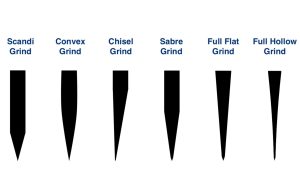
Photo from noblie.eu
Avoid using a fully Serrated Edge on a survival knife if possible. It is a nice addition to the functionality of the blade, but this will only decrease its usability and make sharpening harder. Because Serrated Blades are sawwy, natural materials will only damage it’s edge during sharpening. Consider half-serrated blades instead.
How big should your survival knife be?
Ideally, between 9 and 11 inches, or 220 to 260 mm from point to bottom.Blade itself should be around 5 inches — 110 to 150 mm. From a practical standpoint, this will make the blade usable for precise tasks and fine cutting, while keeping it useful for heavy-duty tasks such as hunting, woodwork or self-defense. This is also the optimal range for survival knives if you want ease of carry.
Look for 2.5 mm blade thickness. This will ensure the blade won’t bend or break from prying or any other demanding tasks, while keeping weight/use ratio at bay.
What to choose for a survival knife — full or partial tang?
“Tang” is the word for the back of the blade connected to a handle. It can be of various forms, such as Skeletonized, Partial, Stick — also called Rat Tail — and Narrowing. Each of them serve different purposes and provide certain benefits in edge scenarios, such as the case with Full Tang design.
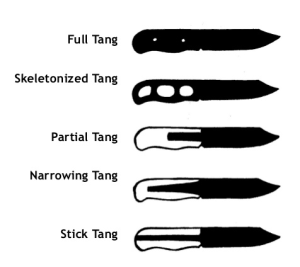
Photo from quora.com
For a Survival Knife look for Full Tang design. Among other options, Full Tang blades provide more durability to the knife, as there are less weak spots between blade and handle. Wide surface area between Tang and Blade makes it resilient to shock, such as during chopping or heavy cuts. Compared to other designs, you are less likely to have the knife’s blade «slip out» of the handle, given the wear and tear applied.