
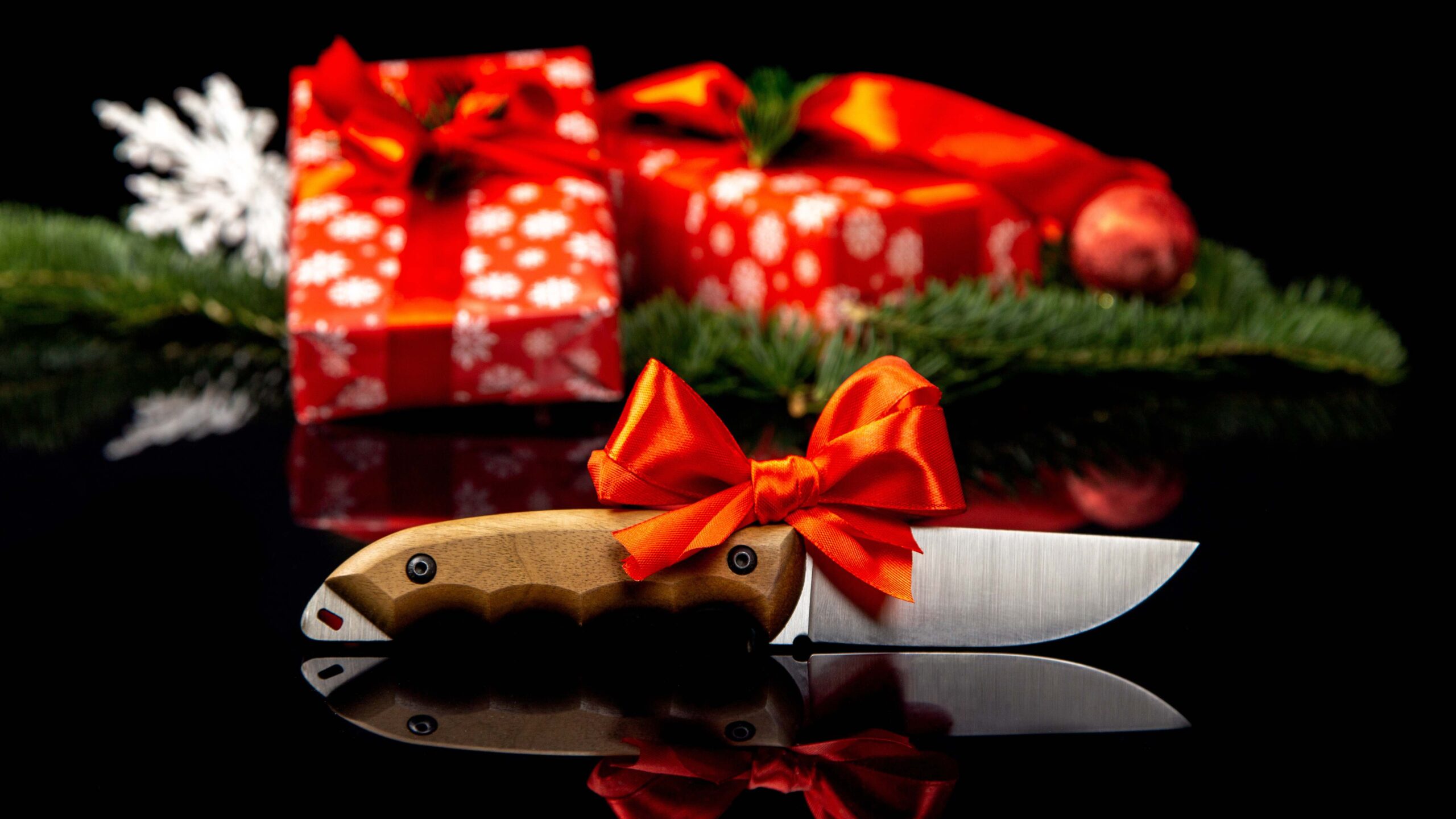
Looking for a knife to make a good present, but want to do it properly? This article will help you to account for cultural differences in knife giving — from simple, to advanced.
Knife as a present — traditions and customs
Through the culture, knife giving is perceived in mostly the same way. In Eastern and Western traditions there is a shared common belief about knife giving, which, however, despite being almost identical, has different explanations for the act.
Throughout history, there are shared beliefs about the power of knives severing ties, bonds and relations. This may have an interesting explanation, since knives are around for 2.5 million years of one form or another. Since relationships were often self-explained as “ties” between people, which hold them together the same way rope holds two logs, the concept of a “knife” as all-cuting tool introduces fear of severing these ties.

Everyone believes that it’s necessary to give a coin, but they all have different explanations. For example, Asians say that if a person cuts themselves with a gifted knife, they will harbor ill thoughts about the giver. To prevent this, the knife is sort of “sold” in exchange for a coin. The person, upon receiving the knife, gives the coin, resulting in an honest transaction. This prevents negative thoughts about the giver if one were to get cut with the knife.
Europeans believe that a coin is indivisible; thus, the symbolism lies in the fact that a knife won’t sever friendly ties if protected by the coin. Others believe that a knife becomes greedy if not offered a sacrifice – in other words, a person will inevitably cut themselves with such a “hungry” blade. Therefore, when a person gives a coin for a knife, it is believed that they are offering a sacrifice to the blade, ensuring it won’t “cut” them.
Scandinavians, on the other hand, regarded the knife as the greatest of gifts. Since Scandinavian culture was closely tied to battles, which was reflected in their beliefs and perspectives, anything that could be beneficial in battle held symbolic significance. The ordinary knife, in addition, was also a vital survival tool in the harsh climate, as it facilitated tasks such as gathering food, skinning, and hunting. Hence, the knife was seen as a symbol of protection and life – the most potent gift possible, with no rational reason to decline.
Another tradition involving the gifting of knives is connected to family bonds. For instance, a couple in love – be it husband and wife or betrothed – should never give each other knives for the same occasion, even if it’s done in different years. Meaning, one cannot gift a sharp object to their significant other for Christmas, as it would bring bad luck to the relationship.
Debates about the origins of this tradition continue to this day. Many sources attribute the myth’s origin to Japan and China, as they have a close cultural connection to blades spanning over 5000 years. It is believed that after the establishment of trade links with the West, the myth about gifting a coin migrated to Europeans. However, traces of this belief also exist in Greek culture – there, it was believed that one should not give a knife directly into someone’s hands; instead, it should be placed next to the person it is intended for.
In Celtic tradition, it was believed that the tip of a blade should be covered with a coin. It was thought that the sharpness of a knife could cut through bonds of friendship as easily as it cuts ordinary knots. In Argentina, they also believed in the symbolism of how a knife is presented: if it was offered handle-first, it was a gesture of goodwill, while handing over a knife with the blade exposed, even in its sheath, was seen as an act of extreme defiance.
In the cultures of China and Japan, there is another explanation for exchanging a coin for a knife.
In Japan, it is customary to give a knife along with a coin – it should be placed on one side of the blade when you present it. When the blade is given in exchange for a coin, it should be interpreted as a great honor and luck – to receive a magnificent sword from a shogun for just one coin. Of course, this allowed the samurai to preserve their life. If given on a wedding, your knife would be returned to matter how it was presented, as it symbolizes severing the relations. In Chinese tradition, a gifted knife is seen as an initiative to sever friendly relations. There’s even a separate saying for this – 刀两断 (yì dāo liǎng duàn), which literally means “One knife, two halves.”
How to give a knife as a gift properly?
Here’s a universal guideline on how to give a knife properly as a gift in any situation and culture, accounting for different beliefs and symbolism:
- Knife should not be placed directly in the hand of a person receiving the gift; Instead, put it in a box — or even sheath — and hide it in plain sign.
- When giving a knife — put it bladewise to your side, and keep handle outwards; Putting coin in the sheath to a knife is also a good idea, as it will make the formal procedure completed successfully in most of the traditions;
- Put one coin at the side of a blade, and one coin at the tip of a blade; If it’s a foldable knife, then place the coin near the knife, as close as possible.
When receiving the knife:
- In Western Culture — pay with a small coin in exchange; This can be anything, from German Pfennig to American Dime. There are no restrictions on the size of the transaction, however, as you can return any type of a coin or paper cash in exchange;
- In Eastern Culture — accept the knife along with a coin;
- In Northern Culture — nothing is expected in return, as you receive the most powerful gift, so pour a beer for the fellowship you have.
In various cultures, the perception of a knife as a gift is deeply intertwined with its historical significance and its role in human survival throughout history. As a tool that accompanies individuals throughout their lives, a knife holds symbolic value in every culture. It is evident that in some cultures, presenting a knife as a gift must be done with careful consideration, as it may be interpreted negatively if not done appropriately, while in others, it is regarded as one of the finest gifts one can receive on any occasion. Therefore, it is essential to take the time to understand the gift-giving customs of a particular country or culture before presenting any gift, including a knife.
Ultimately, the appropriateness of such a gift depends on the individual and their attitudes towards traditions. A knife for a knife enthusiast is a wonderful gift that can bring people together and demonstrate a deep understanding of the recipient’s interests and passions.