

Depending on your definition of «never», there are several options, ranging from legends and fantasy — to practically doable solutions you can benefit from. In this article, we’re going to cover something practically useful to you.
Knife that never needs to be sharpened — does it exist?
Sort of! We’re spent 2,6 million years as a species trying to answer the question in the headline, and there are prominent solutions to the problem.
There are 3 approaches to the question — material, sharpening techniques and type of the blade grind.
- Material. Since sharpness is a property, hardness and quality of the material determines the longevity of the blade. Material itself is what determines edge retention of the blade, or its ability to hold sharpness. In general — stronger the material, the longer the edge of the blade is going to last — remaining sharp under any given conditions.
- Sharpening techniques. The most obvious answer to the question is a knife set with an automated sharpener along the knife holder — such technical solutions exist not only on paper and available to anyone, willing to pay the premium for the delivery. Nonobvious answer is that by following sharpening instructions for each blade grind type, on average, the knife can hold its sharpness for 4 to 6 months.
- Blade grind. Traditionally, there are 6 types of common blade grinds (learn more in the article “Knife Blade Grinds — What’s the Difference”). For example, Flat Grind is one of the most versatile, while Hollow Grind is designed to be the sharpest of them all. Depending on the type of Blade Grind, you can predict how long it may last, but it also requires a decent steel type, such as CPM S110V or AUS-8.
5 types of knife blade that will remain sharp for 1/5 of forever
First of all, there is no knife that never needs sharpening. But some of them are designed to remain sharp longer than others. Here are 5 types of knives, known for their edge retention properties, which may come as close as possible to never wear off.
Ceramic Knives
Ceramic Knives, made from dry-pressing and firing of zirconia powder with solid-state sintering. They score around 8.5 on Mohs scale, outrunning normal steel at 4.5 and coming close to hardened steel at 7.5 to 8. Their edge can hold for virtually an infinite amount of time — given proper treatment, never rusts and remains stain-resistant.
Upsides:
- Thin, lightweight, resistant to corrosion and staining;
- Can hold sharp edge longer than steel, just by being harder;
- Overall good, if you’re willing to make compromises.
Downside:
- Brittle edge. You are limited to cutting only soft material with a Ceramic Knives blade, and should avoid cutting frozen food, bones, burlap, fibrous materials;
- Sharpening. Boils down to the blade being brittle and ceramic, next to impossible if you don’t have proper tools.
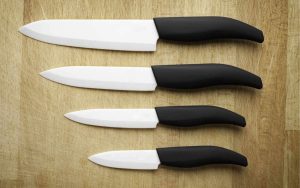
Photo from preciseceramic.com
Serrated Blades
Serrated Blades can maintain their sharpness much longer, compared to their straight-edged cousins, because of the way they are made — instead of straight edge, serrated knives use a series of teeth to cut through food.
Upsides:
- Can maintain sharpness longer, than straight-edged blades;
- Good for tough, fibrous material, such as bones, wood, burlap, netting and frozen foods;
- Best suited for outdoors and combat knives;
Downsides:
- Less precise than straight blade;
- Near impossible to have clean cuts for a utility knife.
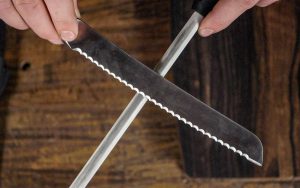
Photo from worksharptools.com
Granton Edge Blade
Characterized by a series of small divots or scallops along the blade bevel, which help to reduce friction and prevent food from sticking to the blade. You can find Granton-Edge on most of the Santoku Knives, as it may help to maintain their sharpness over time.
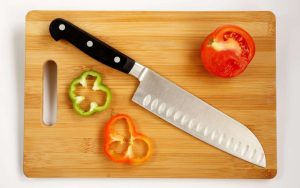
Photo from leeknives.com
Titanium Knives
Rated 6 on Mohs hardness scale and known to be lightweight, durable, resistant to any type of corrosion and one of the most biocompatible metals out there. However, it is extremely tough, sometimes brittle and hard to work with.
Upsides:
- Viable option for scuba knives, will survive salty sea, good for water— and corrosion— related scenarios.
- High tensile strength and temperature stability,
Downsides:
- Requires proper forging techniques to come on-par with steel blades;
- Won’t hold the edge, unless properly hardened and maintained;
Blade from a decent steel
High-end steels, like 440C, AUS-8, ATS 34, are best suited for utility knives. While A2, D2 and M2 are good for outdoor blades with W2 being the best option. Other notable picks are 26C3 — used in razor blades and scalpels; and 80CRV2 — also known as «Swedish Saw Steel». From an Edge Retention perspective, CPM S110V is considered «the best», with VG-10 and S30V being notably good alternatives.
Have a great day and keep in mind — «there’s steel for everything».