
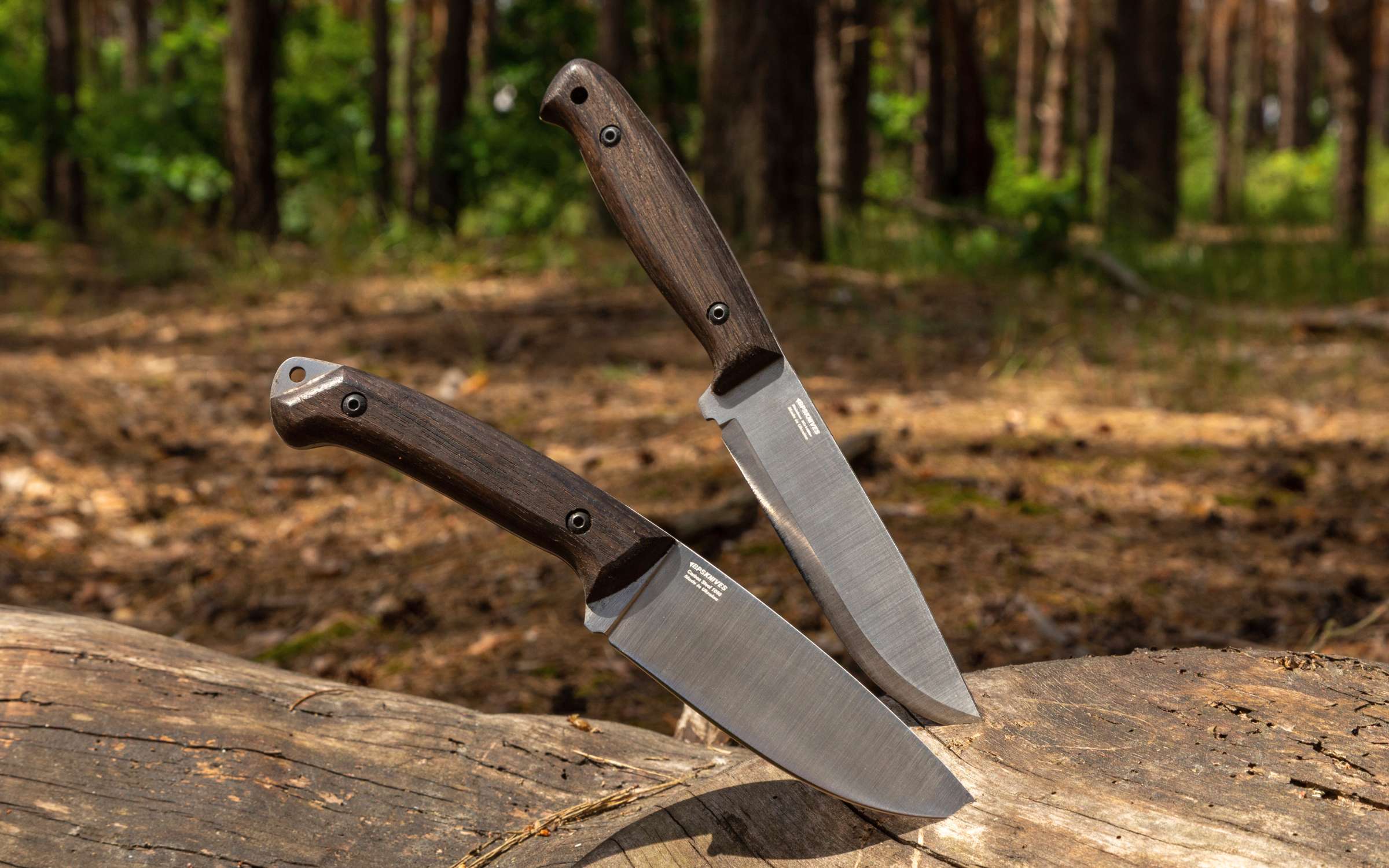
There are 6 types of common blade grinds you can find at your traveler’s knife, camping chopper, axe or even a kitchen knife. Each blade shape serves its purpose, tune in with the article to find out what is best suited for your specific task.
6 types of blade grinds
Here is the list of 6 possible grind types and how you can effectively utilize them.
Full Hollow Grind, or Hollow Grind
It is made with the use of a regular grinding wheel, by pressing the blade against the grinding surface to form a concave shape of the cutting edge.

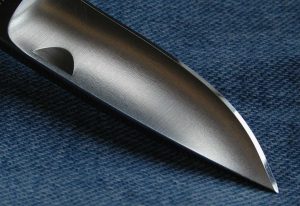
Photo from bladeforums.com
- Hollow grind is perfect for scenarios when you need a razor-sharp blade, making a thin cutting edge and strong spine for added strength;
- It’s mostly used on blades where slicing ability is far more important than shock resistance, such as old-fashioned razors used by Suini Todd;
- You also want to use it with short blades, rather than long ones, and avoid trying it with a chopping blade — hollow shape may cause the edge to crack once too much force is applied;
- Hollow Grind is best suited for slicing, and works best with a caping blade, skinners, hunting knives, straight razor;
- Hollow Grind is easy to sharpen, but fragile compared to other grinds, as any chopping designs will make it dull real fast real quick.
Full Flat Grind, or Flat Grind
It’s the type of blade grind you are going to find on every kitchen knife. Great example of knife with Full Flat Grind – Savage CSH by BPS Knives.

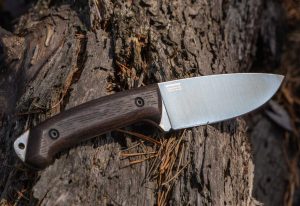
- Blade bevels are symmetrically flat, while the cutting edge takes a V-shape;
- This is the most versatile type of grind with «Above Average» mark in cutting, slicing, piercing and decent resistance to dulling;
- Flat Grind is suited for any scenario, such as hunting, daily carry, kitchen or self-defense;
- Its sharpening potential is lower than that of Hollow Grind and Chisel Grinds.
Sabre Grind
Grind for hard-working blades, suited for chopping, hence the name — Sabre Grind.

Photo from dlttrading.com
- Best suited for camping and combat knives and has excellent durability, making a strong blade;
- Cutting ability of Sabre Grind is lower, than of other types and will be less impressive;
- Due to chopping-oriented focus, Sabre Grind is best suited for knives with added weight or thick blade;
- Sabre Grind is common for Camping, Self-Defense, Military and Tactical knives.
Chisel Grind
It is a single-bevel blade, with only one sharpened side. This grind type is uncommon, and used for specialized knives.

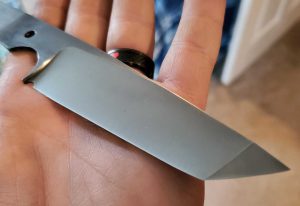
Photo from reddit.com
- Best suited for cutting soft materials, but won’t be useful with abrasive or tough objects;
- This type of blade is for specialized knives only, such as Sushi knife;
- Chisel grind allows for one of the highest sharpness levels, along with ease of sharpening.
Convex or Moran Grind
The opposite of the Hollow Grind, when the blade slightly bows out. In theory should not have an edge bevel, in practice often has a micro bevel when resharpened.

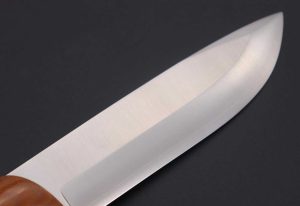
Photo from japaneseknifedirect.com
- Provides added support to the blade, allowing it to withstand a decent amount of shock, such as during chopping;
- This is one of the best edge-supporting grinds for the blade, used in original Japanese katanas for them to cut armor without breaking;
- Best suited for choppers, axes, large bushcraft knives, massive-blade knives, machetes;
- Difficult to maintain, requires skill and uncommon sharpening tools, performance vary depending on the angle of the edge.
Scandi or Scandinavian Grind
It is a short flat grind on a thin blade. Great camping knife with Scandi Grind – BS2FT CSH by BPS Knives.

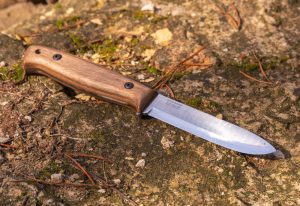
- Strong edge, along with simple sharpening theory and strong blade tip;
- Makes a strong blade, which is easy to sharpen, and is best suited for bushcraft, wood chopping and carving.
- Not a kitchen slicer grind, but serves best for heavy-duty blades and as a reliable traveling ornament.
Conclusion
Overall, there’s a grind for every scenario, but most of the time you are going to pick between Convex, Flat and Scandi grind for outdoor blades. For cooking knives it’s better to pick Flat, Hollow and Chisel grinds, but take into account that Hollow grind isn’t suited for chopping or cleaving, so make sure you are trying to use it only with a slicing knife.