
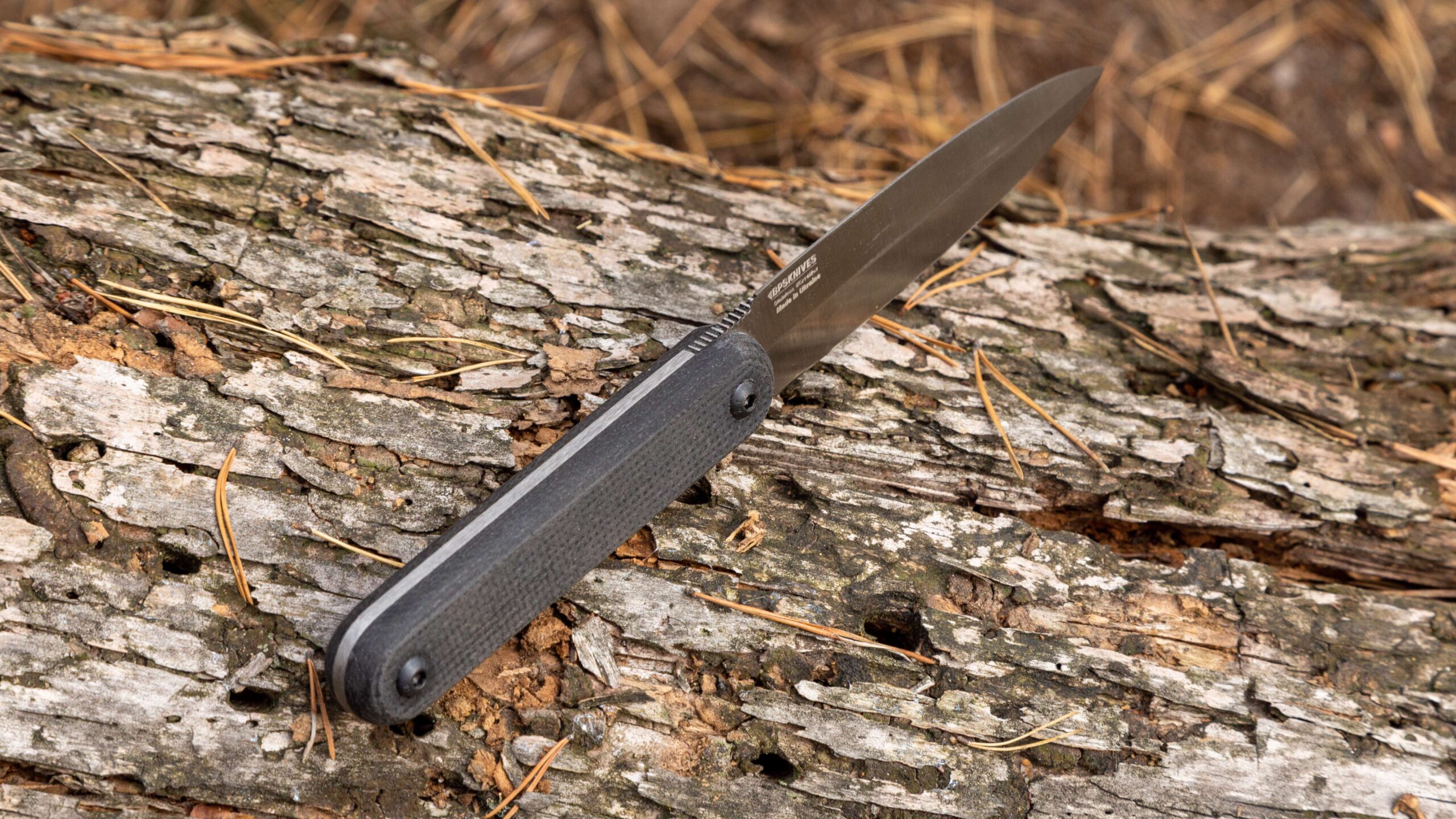
What’s common between an old circuit board, early ICBM warhead, hard hat and a knife? That’s not a psychology test on weird associations, but the answer is much more interesting than you think. Read more to find out what Micarta is, what it is made of and why.
How Micarta is made and why?
Micarta, nicknamed «The Steel of the Plastic Industry», is the brand name for a family of composite phenolic laminates, made from natural fibers and impregnated with thermosetting plastic. It was invented on a sunny day of 1910 by George Westinghouse, as in «Westinghouse Electric», who took inspiration from phenolic resins made by Leo Baekeland, like Bakelite.
In a nutshell, Micarta is a layered natural fiber impregnated by phenolic, epoxy, silicone, or melamine resin, compressed under pressure and heat — think about pressing two wooden boards together with clamps, but much harder. Micarta can be made with linen, canvas, burlap or paper layers. In a way, Micarta is a Denim from the world of plastics and is used everywhere — from early ICBM warhead heating shields, electric guitars and handgun handle grips, to knife handles and BBQ utensils. You can also find it in old slot machines, jukeboxes, cars and basically every piece of furniture from 50-ies to 70-ies.
The key principle behind Micarta is simple: with enough layers of natural fiber, thermoset and pressure you can turn layers of natural fiber into a dense composite. Upside of this method is that grip qualities of the handle will not degrade overtime, rather, they will improve and adjust to the hand from the extended use.
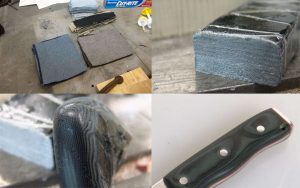
Photo from cartercrafts.co
Can you make Micarta by yourself at home?
Fun fact: you can make Micarta at home and get yourself decent material — it won’t be as good as the original, plus you are going to use epoxy instead of phenolic thermoset. Crafters these days are trying any decent material, even Denim.
To make Micarta, you are going to need:
- Materials: you’re going to need a lot of natural fiber, such as linen, or even denim.
- Medium: for an original Micarta craft you are looking for thermosetting plastic, or thermoset — one that can be «cured» to achieve better density. But these days artisans prefer to replace it with epoxy and skip the «curing» part altogether.
- Tools: vises, clamps or holders of sorts — you are looking for enough pressure to crush a wooden plank. Don’t try using a hydraulic press if you can’t distribute pressure evenly and look for containers you can safely put pressure on.
- Process: Layer, Pour, Spread, Repeat until out of material. There’s no particular order and you’re going to end up with makeshift Micarta, which still would be a decent material.
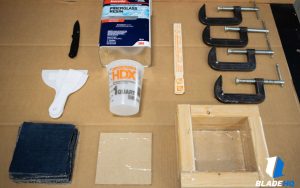
Photo from bladehq.com
Why is Micarta so expensive?
Because it’s reliably durable and pleasant to hold in your hand. Original recipe also accounted for increased grip qualities over time, such as those of wooden handles without the added downsides. Many artisans are noting that Micarta is a material of choice for most of the premium-level knives due to it’s grip qualities.
Why can Micarta handles be expensive?
- Durability. You can find Micarta made for WW1 and WW2 handgun handles, «vintage» pre-WW1 and pre-WW2 ones, sheets of it.
- Versatility. Micarta handles can be sandblasted, polished, grinded and shaped to almost any form, without fear of damaging material in the process.
- Toughness. On a basic level it’s a 100+ layers of fiber reinforcing a single unit of dense thermoset, cured under high pressure and temperature. Micarta scores 105 on Rockwell M scale, coming on-par with copper and aluminum alloys.
- Labor costs. Cost-wise, Micarta production is pricey, be it makeshift blacksmith or production facility, it’s still a tedious process, which requires curing, layering and precise material placement.
- Added crafting costs. Often, artisans have to cut, grind and finish the material on their own, which takes time and dedication.
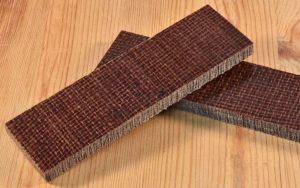
Photo from etsy.com
Why is Micarta used to make knife handles?
There’s ongoing debate in the knife-making society on whether to use Micarta or G-10.
Basically, here are the reasons why Micarta is used to make knife handles
- Longevity and durability: It can handle scratches and deformations with as much as 875 kg per square centimeter lengthwise and up to 612 kg of force crosswise. In much simpler terms — it is rather a blade that will perish, than its handle.
- Reliability: be it paper, linen or canvas, Micarta is always dense and durable. Handle itself requires once-a-year maintenance, while grip qualities will get better over the time;
- Aesthetic look. Finished Micarta handles will remain gleamy and hold on to initial polishing, even after extended use and won’t use premium look and color over time;
- Waterproof. This is synthetic material with multiple layers, reinforced by phenolic resins, heat, pressure and thousands of canvases. According to numbers, Linen Micarta is much better at moisture repulsion (1.8 % vs 2 % in 24h), but even this won’t save natural fibers from soaking in some of the substance from your hands.
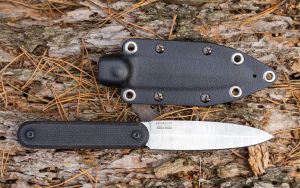
The company BPS Knives has its own production of Micarta. In order to obtain the highest quality composite, the company has decided to manufacture this material independently. Through the individual tuning of processes and the selection of high-quality materials, they achieve a dense, durable, and resilient material suitable for use in knives. This makes the material suitable for both EDC and camping or bushcraft knives.
For example, a model with a Micarta handle from BPS Knives is the Citizen SSH.
Micarta in a short list instead of conclusion
- Durable, can withstand aging, suitable for hardworking blades, most weather conditions, stress and shock.
- Pleasant to hold and versatile, comes in different colors and material types for any task.
- Grip qualities of the Micarta handle will endure overtime and improve with use.
- Handles for hard-working tools made from it won’t «kick» your hand as hard, as the case with much more solid options, like wood or fiberglass.
- Can be made at home using epoxy, clamps and multitude of linen layers.
- Popular in the industry as the «ol’ reliable» solution, tested by 113 years of practice.