
Impregnated cloth vs impregnated fiberglass, what’s better and why? And should you consider the differency while selecting a knife for outdoors, kitchen, diving or traveling activity.
Micarta vs G10 – what is the difference
Essentially, both materials are layered composites, which use the same principles, developed by George Westinghouse. Both — G-10 and Micarta — may look alike, because of the similarity in facture from the side.
- Miracta uses phenolic, epoxy, silicone, or melamine resin, derived from Bakelite and is conditioned with heat and pressure to achieve better hardness. It uses paper, canvas or linen and sometimes burlap as a basis for layers. Natural fiber gives out a fibrous’ look from the side — cloth strings would be evenly distributed along the material, given proper light angle.
- G-10 — also called garolite — uses only epoxy resin and is only made from fiberglass and its derivatives, such as A, C, D, E, Advantex, ECR, AR, R, S-2, M, T, Z, are the fiber (fiber or fiber). To create garolite, multiple layers of glass cloth or fiberglass are stacked and covered in epoxy. Afterwards, laminate is compressed and heated to achieve hardening.
Micarta Key Comparison Points
Micarta is a long-lived principle of impregnating phenolic laminate made out of linen and canvas fabric, which makes it durable, and after curing it strengthens from both — reinforced fabric and hardened thermoset. Does it make Micarta more expensive than G-10 and what type of material should you consider for the knife handle? Let’s find out.
- Micarta is a century-old material, tested by time. Micarta is a brand name for material created in the 1910-ies by George Westinghouse — founder and pioneer of «Westinghouse Electric». The company BPS Blades has its manufacturing of Micarta. In arrange to get the most noteworthy quality composite, the company has chosen to make this fabric autonomously.
- Micarta gives the durability of steel without the added weight. One of the nicknames Micarta has is «The Steel of Plastic Industry», which refers to its hardness — given the Rockwell scale, it scores almost 105. For reference, in terms of hardness, this puts Micarta on par with copper, iron and aluminum alloys, cast iron and medium case-hardened steel.
- Comfortable to hold. Since Micarta is made from natural fibers, eventually they are going to copy the shape of your hand and is generally noted to be a choice of hand’s comfort. For example, you want to use Micarta if your hand skin is thin and you are prone to feel slightest edges and corners of the material while holding it.
Tensile strength of the Micarta — Linen, Paper, Canvas
Brief reminder, that tensile strength is how much pressure material can resist before deforming into a pulp.
Tensile strength chart for Micarta (Linen woven)
| Tensile Strength | Flatwise PSI | Crosswise PSI |
| 12500 | 8750 | |
| Compressive Strength | Flatwise PSI | Edgewise PSI |
| 37000 | 25000 | |
| Flexural strength /bending strength | Lengthwise PSI | Crosswise PSI |
| (On 0.125″ thickness) | 16500 | 14000 |
Tensile strength chart for Micarta (Paper woven)
| Tensile Strength | Flatwise PSI | Crosswise PSI |
| 15000 | 12000 | |
| Compressive Strength | Flatwise PSI | Edgewise PSI |
| 32000 | 25000 | |
| Flexural strength /bending strength | Lengthwise PSI | Crosswise PSI |
| (On 0.125″ thickness) | 13500 | 11800 |
Tensile strength chart for Micarta (Canvas woven)
| Tensile Strength | Flatwise PSI | Crosswise PSI |
| 9000 | 7000 | |
| Compressive Strength | Flatwise PSI | Edgewise PSI |
| 39000 | 24500 | |
| Flexural strength /bending strength | Lengthwise PSI | Crosswise PSI |
| (On 0.125″ thickness) | 17000 | 16000 |
Why is Micarta used for knife handles?
Artisans are noting that Micarta has a good performance in terms of grip, maintenance and stability.
- Other notable aspects are resistance to heat and heating, wear and tearing during the outdoor activities. There’s also resilience to chemical conditioning, which may save your blade from rapid corrosion.
- Handles from the Micarta are much more resistant to chipping or cracking when compared to other options. Such handles can be easily customized for various design options without the fear of damaging the material — you can shape, polish or machine Micarta handles without significant damage to it.
- High customisation. Such knife handles can be customized in a variety of designs, textures, and patterns. Additionally, it can be shaped, machined, and polished to achieve the desired appearance.
- Micarta can be made «on-site» by blademaker, during the knife-making process, which makes it versatile material for a handle.
- Micarta has a good dimensional stability — the handle won’t shrink or expand as much during rapid changes in humidity and temperature. You can also say that after being submerged, Micarta handles won’t soak up as much liquid as wood. One of the best types of Micarta for water-resistant purposes is Linen.
- Micarta handles are good for electric tools, since they have good insulation properties.
Micarta is perfect for heavy-work and hard-work knives because of the good shock absorption capabilities of the natural fibers. Choppers, axes and heavy-knives are going to benefit from Micarta handles, since it will go much easier on your hands, absorbing most of the shock.
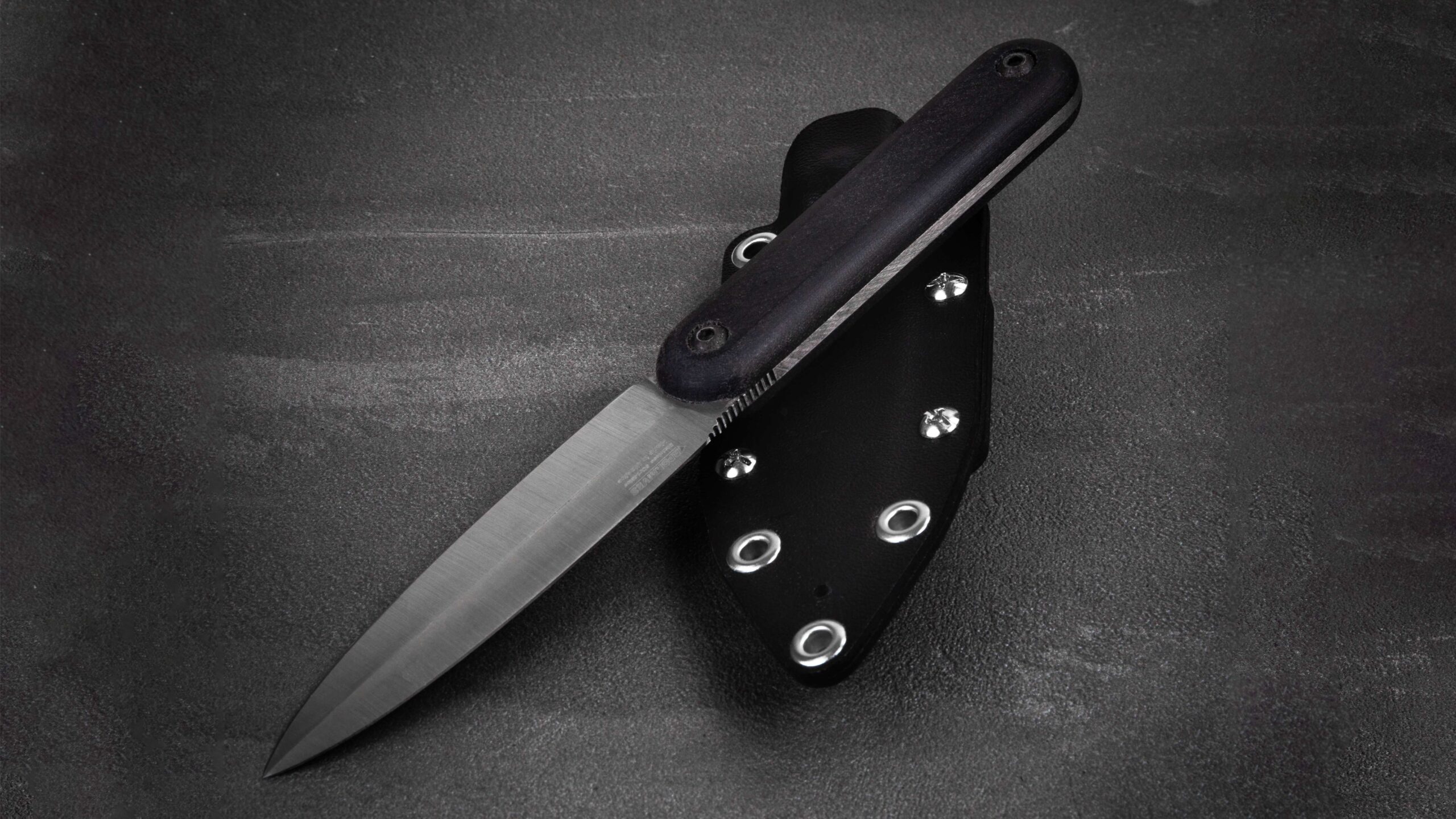
Great example of knife with Micarta handle – Citizen SSH by BPS Knives.
G-10 Key Comparison Points
- High standards behind the material. Before becoming the material of choice for knife making, G-10 was a substrate for printed circuit boards, and is able to show high levels of chemical resistance and electrical insulation at room temperature, high humidity and most conditioning.
- Widespread use as a secondary material. G-10 is often used to reinforce edges of fiberglass-coated wood, to protect points-of-contact during shock contacts, or serve as a brunt of the blow, protecting material from major damages.
- Strength of the material. G-10 is known as a mix of Epoxy and Fiberglass under a high pressure and heat, which result in one of the highest Tensile Strength values among composites.
- On a Rockwell hardness scale G-10 scores a 110 — outrunning the Micarta by 5 points, which makes it much stronger and puts it near steel, copper and aluminum alloys.
- Resistant to absorbing gross stuff and is good for sanitary environments. G-10 is a less porous solid composite than Micarta, so if you had something gross on your hands — it won’t be absorbed as much as by Micarta. Same is true for absorbing the hand oils and dust particles.
Why is G-10 used for knife handles?
Artisans favor G-10 for the:
- Resistance to extreme conditions, such as to extreme heating, like during a long trip in a desert, or desert-like conditions G-10 won’t lose its initial strength. During cold conditions, such as Iceland winter or Arctic travels, material is known to be reliable and resistant to spontaneous breaking.
- Zero-reaction to humidity, moisture or submerging — because G-10 is basically a slab of epoxy resin with fiberglass layers, material doesn’t absorb moisture, as there’s no place for the water inside the densely pressured composite.
- Epoxy resin makes it harder, which is twice as strong as normal or phenolic resin. Side-effect of that is good insulation properties and high chemical resistance of the G-10.
- One of the advantages is that G-10 can be truly dyed to a pure shade of almost any color, making it a good choice for «exotic» handle designs.
- G-10 is harder to get «dirty», as opposed to Micarta, and is generally known to be more stain-resistant.
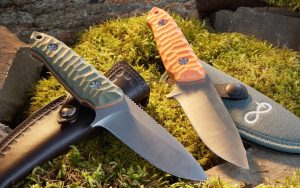
Photo from all4shooters.com
There’s also a hazards of G-10:
- It’s dangerous to grind the G-10 without protection gear. Fiberglass and epoxy make a fine dust cocktail, which is known to increase risks of developing lung cancer and is generally dangerous to people with asthma or other respiratory disorders.
- You are going to wear a respirator and set up appropriate ventilation in your work space to work with G-10. For example, you can build a venting box, which can suck out dust and fine grains from the workspace.
- Epoxy resin is flammable, and will burn vigorously once ignited, giving off poisonous gasses. Because of this, handles from G-10 are better to be kept away from direct fire sources. For this reason, G-10 is replaced by FR-4 in certain applications.
Tensile Strength of the G-10
|
Tensile Strength |
Flatwise PSI |
Crosswise PSI |
|
|
40000 |
35000 |
|
Compressive Strength |
Flatwise PSI |
Edgewise PSI |
|
|
60000 |
35000 |
|
Flexural strength /bending strength |
Lengthwise PSI |
Crosswise PSI |
|
(On 0.125″ thickness) |
55000 |
45000 |
Grip qualities of the Micarta vs G-10 handles
- Micarta comes on-par with Wood in terms of grip levels, while maintaining an overall sleek look.
- Handle Grip benefits from the use of natural fibers in Micarta. Natural fibers are known to absorb pressure better than hardened epoxy with fiberglass. With time, texture of the handle will slowly become facture, improving grip qualities of the handle.
- Visual appearance of the Micarta handle is sustained during wearing, so if you are using a gleamy handle — it won’t become less light-reflecting with use.
- No matter how long you are going to sustain wear to the Micarta — the handle will remain firm to the touch and is able to sustain a gleaming surface overtime.
- G-10 handles are always prone to worse wet grip, and feels much slippery if compared to others.
- In terms of longevity — you won’t be able to outlive G-10 or Micarta handle.
Final Comparison of Micarta vs G-10
Essentially, both materials are kind of the same thing, but with different inner workings. From a common use perspective, there’s not much of a difference between the two — both are resilient and strong materials, built with composite layers in mind.
While comparight weight to strength, both — Micarta and G-10 are on-par with each other.
Micarta is handle of choice if you want:
- Reliably good overall grip, which only becomes better with the use;
- Handle that won’t «kick» your hand during chopping or other shock-related activities.
G-10 is handle of choice if you want:
- Cheap & Durable material with good moisture, chemical and heat resistant properties.
Micarta vs G-10 in a short comparison list
- Comfortable to hold and work with. Micarta is known to have a soft texture, compared to other materials, resulting in finer corners and edges of the knife handle. While not as dense, it is still good to hold and lacks a «plastic-like» feel, as opposed to the G-10.
- Micarta is safe to work with without specialized equipment — grinding or shaping G-10 without protection gear is dangerous to your lungs.
- G-10 requires much less maintenance than Micarta, but has a more «plastic-like» feel to it. If you can sustain once-in-a-year maintenance, then Micarta is better for you.
- In terms of shock absorption by the handle — Micarta is the material of choice, while G-10 can «kick» your hand while working.
- Micarta is good for all-round knives, such as any hard-working blade or your daily carry, and is known to provide a notably good wet grip.
- Given the compromises, such as worse grip qualities than Micarta, G-10 is your maximum «price-to-durability» ratio material.