
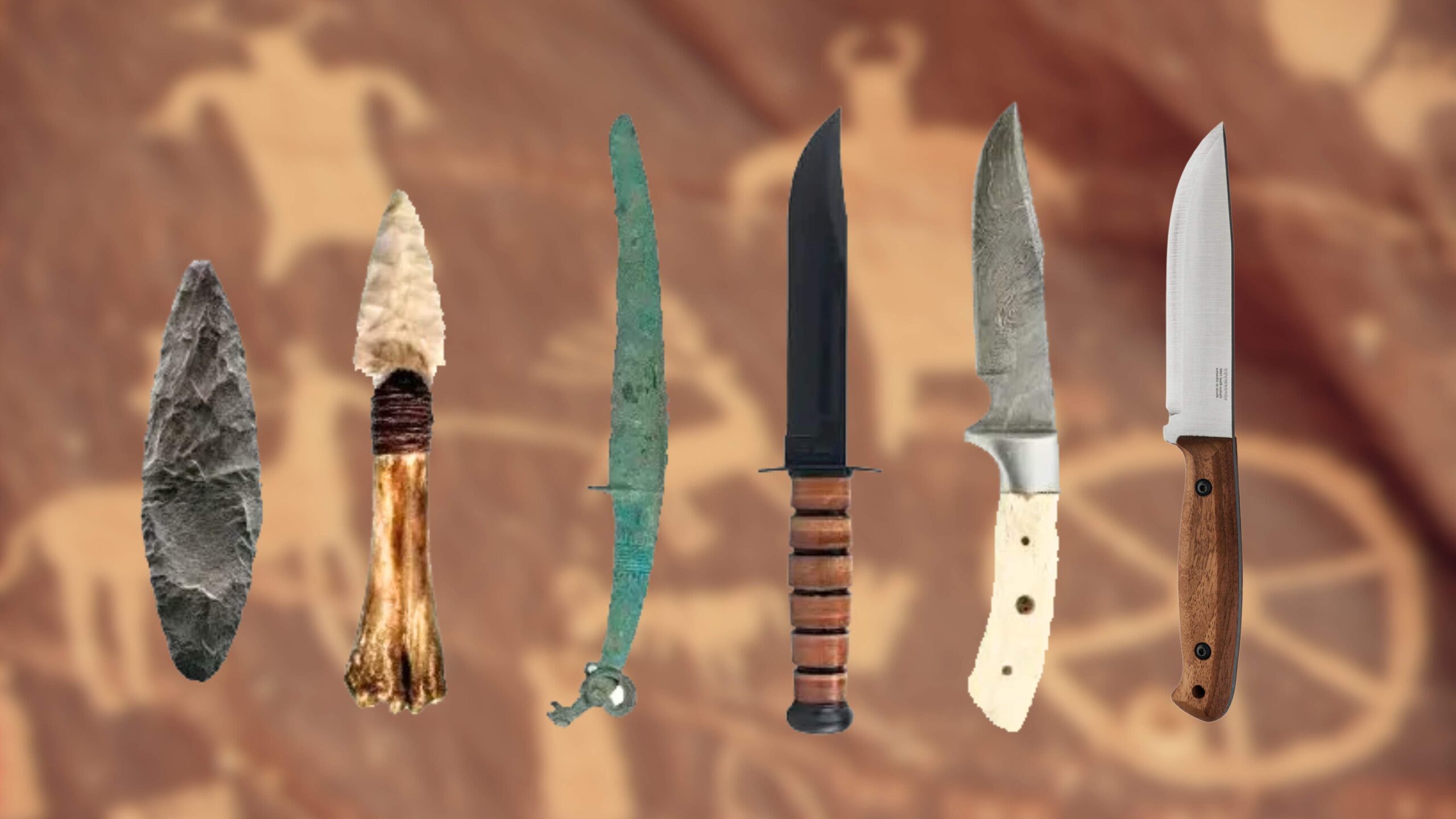
What is — the knife? What part does it take in our history, culture and folklore? How did it influence the world? Let’s recollect notable examples of knives playing an important role in human history.
Knife in the human history — tools of the ancient age
Knife is #1 item on Forbes Top 20 most important tools list, and for a reason. The knives in some way or another have been around for 2.5 million years to date. Newer research shows that the idea of a knife predates modern-day humans, with some cutting tools dating back to 3.3 million years, 700 000 prior to Homo Sapiens. New findings were made in 2015 by a sheer accident on a shore of Lake Turkana in Kenya, at the digging site named «Lomekwi 3». These Lomekwi tools included crude anvils and hammers to make new cutting tools along with sharp flake-like knives for general utility.
During the early ages, knives took different forms, like choppers — heavy stone with sides sharpened by chipping them, used for crude wood processing, meat and herbs grinding. These were made from heavy stones to provide more weight for a cut. Flakes, or early «chip»-like knives, were made by chipping the sides of a flat flint or similar stone. Spear is a relatively recent development, with some findings from South Africa dating back to 500 000 years prior to modern times. Most of the time knives were used for simple living tasks, such as construction, processing firewood, scraping skin, grinding herbs and vegetables or carving meat.
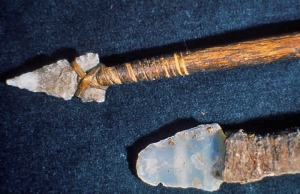
Photo from bryanjtan.com
Knives started to look familiar about 10,000 years ago. This is when we discovered how to use copper for bladesmithing, and around 5000 BC craftsmen of the Near East started to make them from bronze. Usually, bronze knives were made from a single piece of metal, with handles etched in the metal. Later on, handles were made from bone, wood or leather straps.
Here are the image of the first bronze-era knives:
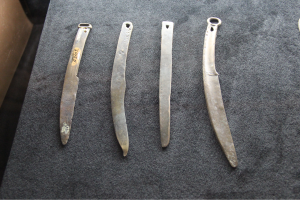
Photo from wikimedia.org
What were the main materials for the ancient knives? Stone-based blades were chipped out of obsidian, jasper, flint or other easily replaceable minerals. Some knives were made of bamboo or hard animal bones.
Were the early knives sharp enough? Yes, in fact, flaking sharpening technique is used to create obsidian blades even today. Gradual chipping created a saw-like edge along the side of a stone, which is what we now call a “serrated” blade. These knives were more than capable of cutting meat into slices, piercing animal hide and filleting the fish.
BC and AD medieval age knives — what are they?
During the early ages, knives became the sword — to conquer and rule. The sword itself became the symbol of power, influence and strength, rooting deep within the culture. Zweihänders, longswords, broadswords, daggers, shortswords and rapiers were made in an everlasting race for the ultimate weapon.
The Bronze and Iron Age can be called a renaissance of the knife. After humanity discovered copper and started to combine it with tin to make bronze the era of experiments in knifemaking began. This phase escalated rapidly when wars and conquests started to make sense thanks to the invention of a boat in around 11,000 to 10,000 BC. Early ships were simple dugouts, but this changed quickly in 4000 BCE when Egyptians added sails to the mix.
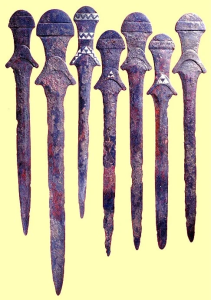
Photo from quora.com
Most of the “in between the ages” blades are lost to the private collections, but there are actually notable samples to be found. During this stage knife designs started to incorporate folding elements in Rome and Austria, with first foldable knives dating back to 600 BCE, and Iberian folding knives dating back to pre-Roman era.
For example, here’s an image of 1200–1500 AD knives.
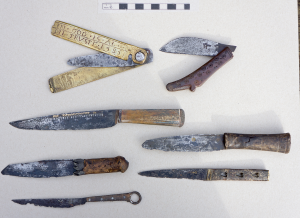
Photo from antiquemetalware.org.uk
When was the first sword made? First sword-like weapons date back to 3300 BC and were found in Arslantepe, Turkey. According to chemical analysis, they were made from arsenical bronze, with a total length from tip to heel of 45 to 60 cm — a blade between a long dagger and short sword. Most of the unearthed samples include ceremonial-like swords with handles encrusted by jewelry or precious metals like silver or gold.
What’s the role of a knife in the culture?
Through the cultures, knives played a significant role. It was used as a sacrificial tool during rituals or as a symbol of status. In Saxon England «scramasax» blade was worn as a sign of a free man, and were often used as EDC’s to handle wilderness living tasks;
Eastern Culture draws heavy inspiration from the swords. Swordsmithing is a crucial part of Japanese culture, which is reflected heavily through the Bushido codex. Some bladesmiths even became part of the legends, as was the case with the Masamune and Muramasa families. In Japan wielding a sword was a status symbol. For example, a Daisho (“大小”, or “small-big”) is a set of two swords, usually katana and wakizashi, which was recognized as a symbol of a samurai or ronin;
One legend has it that if you place a sword made by Masamune in a river and let the lotus flower flow towards the blade, it would be gently moved away from the edge by the water. But if you place Muramasa blades instead, it would draw every flower only to cut it in half.

Photo from quora.com
Knives are everywhere in our culture, from myths, to legends. The curing power of a knife and superstitions around it cemented it as a «severing» tool, which parts everything — life from death, death from the living and soul from the body. Some notable sword names include:
- Gram, also known as Balmung or Nothung, sword of the Volsunga Saga, a piece of Icelandic lore telling the story of a warrior by the name Sigmund. According to the tale, Odin thrusted it in a tree saying that whoever removes it would find no better weapon in all of his life. Sigmund used it in numerous battles, until it was split in half to be later inherited by his son Sigurd who would use it to slay the dragon Fafnir with a single thrust.
- Excalibur, sword of the kings, said to be wielded by Arthur Pendragon, who according to the tales united Britain against Anglo-Saxon invaders;
- Zulfiqar, the gift to the Prophet Muhammed from Archangel Gabriel. Said to have similar properties as Excalibur, such as extra strength and extraordinary sharpness, but only in the hands of a true Muslim warrior.
- Durendal, the sword of a legendary Roland, the military general in service of Frankish/Lombard between 768 and 814 CE. According to the «Song of Roland» this blade was infused with 3 Christian relics: tooth of Saint Peter, tassel from Mary shroud and hair of St. Denis. Roland carried his blade with Oliphaunt — his signature signaling horn.
- Harpe, or sword that killed Medusa. According to the myths, this blade was originally used by Cronus to kill gas father Uranus, then by Zeus to cut open the Kronos’ and release five deities whom he ate and finally by Perseus, who took the Gorgon Medusa’s head with it.
In Christianity, the sword is a weapon of angels, and is often associated with Saint Michael, who is famously depicted holding a sword against the devil. In the Book of Revelation, it is used to express the power behind devine words, describing the word of God as “sharper than any two-edged sword”.
In Hinduism the sword is represented as a symbol of divine power and wisdom, which is held by Shiva and Kali in the Trimurti. Blades were used to express the divine ability to protect the followers from evil and defeat the mortal perils. In Sikhism sword is called «kirpan», and holds a significant meaning of protection, while meant to be used for protection only, it is the required part of a daily religious uniform according to Sikh Code of Conduct.