
How to discern marketing from the facts? Just how many myths are surrounding the modern knife? Should you believe them? In this article we’re going to cover the common misconceptions about a knife.
The common myths about knives
Knives have been around longer than modern Homo Sapiens, but just how much myths are surrounding them now? With some examples pre-dating the early Piacenzian — the age of mammoths in Europe — the amount of superstitions should be immense, but let’s focus on most modern-day beliefs.
Let’s break down the knife superstitions first
Gift-giving a knife is a bad omen to relationships; This is a widespread belief, spanning from China to North America, with every culture in the world telling in unison that you should present a blade along with a coin to protect relationship ties. Is there any merit to this belief? This is a part of our culture and traditions at this point, so be sure to keep a coin around. In Japan when you get a knife without a coin from the superior it was expected from you to take your life with said blade. In Scandinavia a knife is the best gift of life and protection possible, thus requiring next to nothing in exchange — keep this in mind.

Dropping a knife is a sign of conflict and bad luck; While a knife falling to its point is painful to watch or experience, there are several beliefs tied to this. In fact, three of them: a man will visit you soon, your luck is going to be changed for better or worse. Should you believe it? Keeping knives from falling is always a good idea.
Passing the knife hand-to-hand is a sign of disrespect; Greeks considered placing a blade by the sharp side to a hand a bad move towards the other person. According to this belief, this will only bring unluck to the giver, thus placing a knife by the side is advised. This is a widespread belief, that you should not place a knife by the sharp side to the other person’s hand, as it’s a sign of disrespect. Any merit? This is more common wisdom, since the blade itself can have a very sharp edge.
Sharp knife brings luck and prosperity; There is a belief, which goes like this: a sharp knife kept at home can serve as a luck-driving force of the house. On the positive note, it should cut obstacles and bring good fortune. Should you buy this? A sharp knife is a good knife, so keep ‘em honed and prepared for a big journey beforehand.
Wipe your knife after someone uses it; There is a belief that after your knife was held by someone else you should wipe it clean. Aside from the bacteria, it is believed that a negative energy would imbue your knife unless you keep it clean. Sounds like a credible reason to keep a knife clean every day.
There’s also less severe beliefs too, such as passing a knife during the night, breaking the handle, giving blades as wedding and newborn gifts or sharpening at night. Why would you sharpen a knife under a full moon? Knife, however, also serves a symbol of life and protection in Northern cultures — keep this in mind. On the other hand, it is widely believed that you should bury a knife once someone cuts their finger with it, hence the blade will become bloodthirsty. Is there a merit to this? Ask Muramasa.
The not-so obvious modern-day knife myths
Harder the blade, sharper it will stay; Self-evidential logic behind this belief is understandable, however, high hardness does not always translate to a better knife. High HRC score does not translate into a good steel type, chipping resistance, the way HT was done or not or even the grind type of the knife. Hardness does tell you how hard the knife will be, but to remain sharp — consider a blade that doesn’t chip, break or dull easily.
“Dull” blade is a “safe” blade; Absolutely in reverse: dull blades are easy to injure yourself with, since you have to put more force and thus risk the edge slipping away with full blown force of your hand, coming directly at your fingers. A dull knife is unsafe to use, wield and you should consider resharpening it as soon as possible because — remember? — a sharp knife brings good luck and prosperity.
New knives always need aftermarket sharpening; Some cheap Amazon knives actually might need that. We at BPS Knives believe that you are free to do whatever your heart tells you with a knife, unless it’s dangerous to animals and people around you. Our knives come with razor-sharpened edges at all times, hence if you wish to make it even sharper after our machining — consider higher grits, starting from #2000.
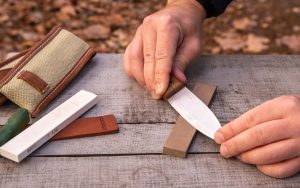
The “X” grind is the superior way to sharpen a knife; Some attribute this belief to marketing campaigns from different blademakers, the truth however is in between the lines. There is a Grind Type for each task, be it fine cutting for single-beveled blades, non-sticky surface of the Santoku grind, sustainable razor sharpness with Hollow Grinds and the good maintenance qualities of the Scandi grind.
Dishwashing a knife is a good idea; Unless you don’t need that sharp edge, pointy tip and uncorroded surface of the steel — don’t try this on a regular basis. Dishwasher uses slightly more aggressive chemicals than your regular soap or kitcher cleaning liquids. Plus, your knife is going to bump into other things, as well as be exposed to high temperatures and aggressive chemicals.
Pricey knife — best knife; There’s a reminder to be written here: when you purchase a knife, you pay for the labor costs, materials and production time. Good blades are easily replaceable in case you lose, break or damage one, but the best blades are easy to maintain through their lifetime.
Stay Sharp.